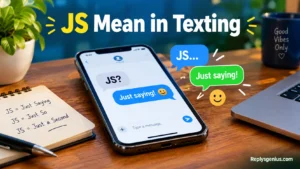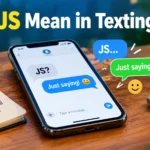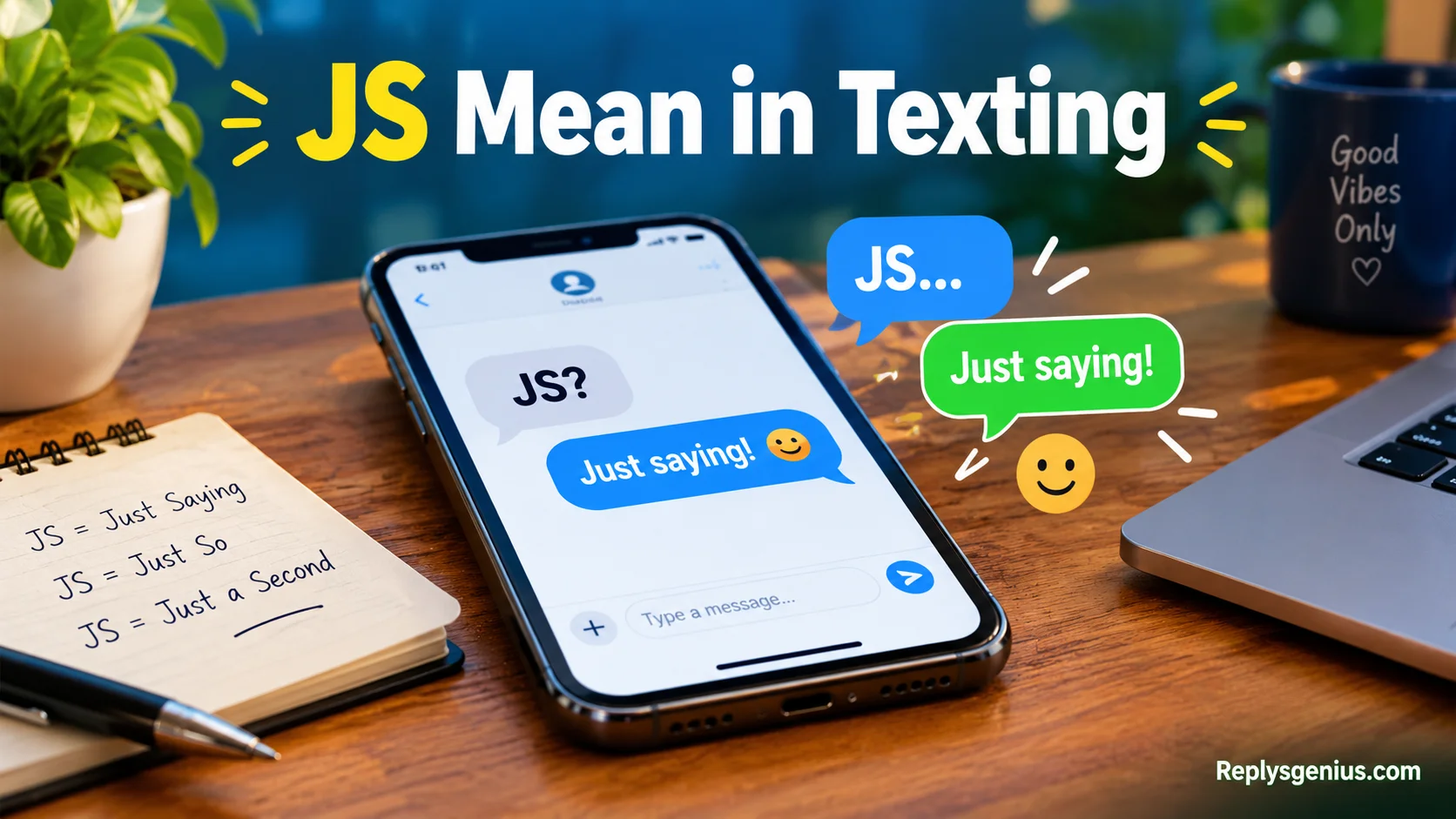
JS Mean in Texting usually means just saying, especially when it appears at the ending of a text message. People use this abbreviation in casual texting and online communication to save time while chatting. On social media and social platforms such as WhatsApp, Instagram, TikTok, and Snapchat, JS can introduce an opinion, observation, comment, or small remark without making the statement feel too formal or forceful. The tone can also make the message sound more casual.
The meaning of JS is context-dependent, so the situation and surrounding text matter. In most casual chats, Just Saying is the natural interpretation, but slang, an informal shortening, or even a typo may be possible. Someone might add JS after a mild criticism or personal observation to soften the statement tone and avoid sounding too serious. However, technical conversations can use JS for JavaScript, especially in digital communication about programming and coding. Checking the complete message, usage, and context helps you identify what the sender means.
This guide helps you learn what JS meaning in text can represent and how abbreviation usage changes across real conversations. If someone sends it after an opinion, comment, or small remark, Just Saying is usually the intended meaning. If the discussion involves coding, JavaScript may be the intended meaning instead. When you respond, consider where it came from, who sends it, and what was written before it. This makes informal communication easier to understand and helps you recognize other meanings without confusion.
What Does JS Mean in Texting?
The most common informal meaning of JS in texting is “Just Saying.” It works as a shortened version of a phrase people already use in everyday speech.
When someone adds JS to a message, they may be expressing an opinion without wanting to sound overly serious. Sometimes the abbreviation softens a comment. Other times, it can make a blunt statement feel even more pointed.
Consider this message:
“You could’ve checked the instructions first, JS.”
The sender is essentially saying, “I’m just saying that checking the instructions would’ve helped.”
The abbreviation doesn’t erase the criticism. Instead, it frames the comment as an observation rather than a direct command.
You may see JS at the beginning or end of a sentence. However, placing it at the end is especially common in casual messages.
| JS usage | Meaning | Example |
| JS | Just Saying | “That wasn’t the best idea, JS.” |
| JS at the beginning | Just Saying | “JS, you could ask her directly.” |
| J/S | Just Saying | “J/S, you might want to check that.” |
| JS in technology | JavaScript | “The JS file isn’t loading.” |
| JS as initials | A person’s initials | “JS called earlier.” |
The important point is simple: don’t interpret an abbreviation in isolation. Read the complete message and consider what the conversation is about.
What Does “Just Saying” Mean When Someone Texts JS?
“Just saying” has a flexible role in conversation. It can introduce an opinion, add a warning, point out something obvious, or make a casual observation.
For example:
“You might want to bring an umbrella, JS.”
Here, JS makes the sentence sound like a casual suggestion.
Now consider:
“You really thought that was a good idea? JS.”
That version feels different. It may sound sarcastic or critical because the surrounding words carry more emotional weight.
This is why JS doesn’t have one fixed tone. The abbreviation itself is neutral. The words around it create the mood.
People often use “just saying” when they want to communicate something while leaving room to step back from it. It’s similar to saying, “That’s just my observation.”
Still, that doesn’t always make the statement gentle. If someone says something harsh and adds “just saying,” the message can still feel confrontational.
JS Meaning in Texting Examples
Seeing JS in realistic conversations makes its meaning much easier to understand.
Example 1: Friendly advice
Alex: “I’m going to drive there after work.”
Sam: “Traffic gets crazy around 5, JS.”
Here, JS means “just saying.” Sam is giving a useful warning without directly telling Alex what to do.
Example 2: An opinion
“I think the first movie was better, JS.”
The sender is sharing a personal opinion.
Example 3: A playful comment
“You bought another pair of sneakers? JS 😂”
The abbreviation adds a joking tone. The sender probably isn’t seriously criticizing the purchase.
Example 4: A blunt observation
“You could’ve replied yesterday, JS.”
This sounds more critical. The sender is pointing out that the recipient could have responded sooner.
Example 5: A warning
“I’d be careful with that website, JS.”
Here, JS works almost like a casual disclaimer. The sender is expressing concern without issuing a formal warning.
These examples show why understanding JS Mean in Texting requires more than memorizing a definition. The same two letters can carry very different emotional shades.
Is JS Friendly, Rude, or Sarcastic?
JS isn’t automatically friendly or rude. Its tone depends on the complete message, the relationship between the people, and the situation.
With close friends, it may sound completely harmless:
“JS, that haircut actually looks great.”
In a disagreement, however, it can sound dismissive:
“You should probably listen next time, JS.”
The second example may feel passive-aggressive because the sender has already made a criticism. Adding “just saying” doesn’t necessarily soften it.
Several clues can help you judge the tone:
- Positive wording: Usually makes JS feel friendly.
- Critical wording: Can make JS sound blunt.
- Laughing or smiling emojis: May signal playful intent.
- Short, sharp sentences: Can make the message feel more serious.
- An ongoing argument: Makes sarcasm or defensiveness more likely.
- A close friendship: Often allows more teasing and informal use.
A useful rule is to judge the whole sentence instead of judging JS by itself.
If someone sends “JS 😂,” the emoji and relationship may matter more than the abbreviation. If someone sends “JS.” during an argument, the period and surrounding context can make the message feel much colder.
JS Meaning on Snapchat, Instagram, TikTok, and Social Media
You can encounter JS on many social platforms because short abbreviations fit naturally into fast-moving online conversations.
On Snapchat, someone might use JS in a direct message:
“That filter is actually better than the original, JS.”
On Instagram, it might appear in a comment or DM:
“JS, this song fits the video perfectly.”
On TikTok, a commenter might write:
“JS, the second part was funnier.”
The meaning remains “Just Saying” when the surrounding conversation is casual.
Social media also creates a special problem: comments often lack the vocal cues that make spoken language easier to understand. When you hear someone say “just saying” aloud, their facial expression and voice can tell you whether they’re joking or criticizing.
Text doesn’t provide those signals as clearly.
That’s why JS can sometimes create misunderstandings online. A sender may intend a playful observation while the recipient reads it as an insult.
How to Tell Which JS Meaning Someone Intended
Because JS has multiple legitimate meanings, context should always come first.
Start with the subject of the conversation. If two friends are discussing weekend plans and someone writes “JS, leave early,” “Just Saying” makes obvious sense.
If a programmer says, “The JS needs to be updated,” the technical meaning is much more likely.
Use these clues:
- Casual conversation: JS usually means “Just Saying.”
- Social media: It often means “Just Saying.”
- Friend or family text: “Just Saying” is a strong possibility.
- Programming discussion: JS likely means “JavaScript.”
- Code or website development: JavaScript is the obvious interpretation.
- A person’s name: JS may represent initials.
- Unclear context: Ask the sender instead of guessing.
The easiest test is to replace JS with “just saying.”
If the sentence still makes sense, you’ve probably found the intended meaning.
For example:
“That color looks better on you, JS.”
Becomes:
“That color looks better on you, just saying.”
The sentence works naturally.
Now try:
“The JS function isn’t working.”
Replacing it with “just saying” makes no sense. That points strongly toward JavaScript.
JS vs. J/S: What’s the Difference?
JS and J/S can both mean “Just Saying.” The slash doesn’t necessarily create a different definition.
People use punctuation differently when texting. Some prefer:
“JS, you should probably call her.”
Others might write:
“J/S, you should probably call her.”
Both can communicate the same basic idea.
The variation often comes down to personal typing habits, platform conventions, or the writer’s preference. You don’t need to assume that JS and J/S represent completely different slang terms.
However, context still matters. A slash can occasionally have a specialized meaning in a particular community, so the surrounding message remains the best guide.
Other Meanings of JS
Although “Just Saying” is common in informal texting, JS has other established meanings.
The most important alternative is JavaScript.
JS as JavaScript
In technology, JS is a standard abbreviation for JavaScript, a programming language widely used to add behavior and interactivity to websites and web applications.
A developer might say:
“The JS isn’t loading.”
Here, “Just Saying” obviously doesn’t fit.
You may encounter this meaning in discussions about:
- Web development
- Front-end development
- Back-end development
- JavaScript frameworks
- Web applications
- Browser programming
- Code repositories
- Software projects
- .js files
For example, a file named app.js is normally a JavaScript source file. Likewise, a developer may describe a project as “mostly JS.”
The technical context makes the meaning clear.
JS as Someone’s Initials
JS can also represent a person’s initials.
For example:
“JS sent the report this morning.”
If everyone in the conversation knows someone whose initials are J.S., the abbreviation may simply refer to that person.
This use isn’t really texting slang. It’s an initialism that happens to use the same letters.
JS in Specialized Contexts
Different industries, organizations, communities, and systems can use abbreviations in their own ways. Therefore, a dictionary-style definition can’t always solve an abbreviation question.
When the standard texting interpretation doesn’t fit the sentence, look at the subject first.
Context beats capitalization.
A person can write “JS” for “just saying,” while a developer can write “JS” for JavaScript. The exact same letters can carry completely different meanings.
Common Mistakes When Interpreting JS in Texting
Short abbreviations create plenty of room for confusion. A few mistakes appear more often than others.
Assuming JS Always Means Just Saying
This is the biggest mistake.
If you see:
“I’m learning JS.”
Don’t automatically interpret that as “I’m learning just saying.” The sentence almost certainly refers to JavaScript if the conversation involves coding.
Assuming JS Always Means JavaScript
The reverse mistake happens too.
If your friend texts:
“JS, you should try the new restaurant.”
They’re probably not suddenly discussing a programming language.
Ignoring the Conversation
The words surrounding an abbreviation provide valuable clues.
A single abbreviation rarely contains enough information by itself. Look at the previous messages and the topic before deciding what the sender meant.
Treating JS as Automatically Sarcastic
“Just saying” can sound sarcastic in certain situations. That doesn’t mean every use is sarcastic.
For example:
“JS, that was a really good presentation.”
That’s simply a casual compliment.
Assuming the Sender Is Angry
A short message can feel colder than a longer one, especially without emojis. Still, don’t assume anger based solely on JS.
Look at the entire exchange.
When Should You Use JS in a Text?
JS works best in informal communication. It’s short, familiar, and easy to understand when the people involved already use texting abbreviations.
Good situations include:
- Texting close friends
- Casual group chats
- Social-media DMs
- Informal comments
- Playful conversations
- Casual online communities
- Friendly advice
For example:
“JS, I think you’ll love that restaurant.”
That’s natural in a casual chat.
The abbreviation also works well when you’re adding a small observation rather than making a formal announcement.
When Should You Avoid JS?
Although JS is useful in casual communication, it isn’t ideal everywhere.
Avoid it when clarity and formality matter more than speed.
Examples include:
- Job applications
- Formal business emails
- Academic assignments
- Official documents
- Legal communication
- Customer-service messages
- Important workplace announcements
- Messages to people unfamiliar with texting slang
Instead of:
“JS, you should review this.”
A professional message might say:
“You may want to review this before sending it.”
The second version communicates the same basic idea without relying on slang.
This doesn’t mean JS is incorrect. It simply means that different situations call for different levels of formality.
Read More: TS Meaning in Text: What Does TS Mean?
JS in Different Types of Conversations
JS in Friend Chats
Friends often use JS casually when giving opinions or teasing each other.
“JS, you always order dessert.”
Depending on the relationship, this could be affectionate teasing rather than criticism.
JS in Dating and Flirty Texts
In dating conversations, JS can follow a compliment or playful observation.
“JS, you looked really good tonight.”
Here, the abbreviation can make the compliment feel less formal. It may also create a playful sense of understatement.
Another example:
“JS, I wasn’t expecting you to be that funny.”
The sender is expressing genuine appreciation while keeping the wording casual.
JS During an Argument
This is where JS can become tricky.
Someone might write:
“You should’ve told me earlier, JS.”
The phrase may sound like the sender is trying to soften the criticism. Yet the underlying complaint remains.
If you receive a message like this, focus on the actual issue rather than reacting only to the abbreviation.
JS in Group Chats
Group chats move quickly, so abbreviations can save time.
Someone might write:
“JS, we’re already 20 minutes late.”
Everyone understands that the sender is offering an observation or reminder.
Still, group chats contain mixed personalities. A phrase that one person considers harmless may sound blunt to someone else.
JS in Workplace Messages
Workplace use depends heavily on the culture of the organization.
In a relaxed team chat, someone might write:
“JS, the meeting room changed.”
In a formal email, however, spelling out the idea is usually clearer.
The issue isn’t that JS is grammatically wrong. It’s that informal abbreviations can make professional communication less precise.
JS vs. Similar Texting Abbreviations
Several texting abbreviations can appear alongside JS, but they aren’t interchangeable.
| Abbreviation | Meaning | Main purpose |
| JS | Just Saying | Casual observation or opinion |
| TBH | To Be Honest | Directly expressing an honest opinion |
| IMO | In My Opinion | Identifying a personal viewpoint |
| IMHO | In My Humble Opinion | Giving an opinion with a modest framing |
| FYI | For Your Information | Providing information |
| BTW | By the Way | Introducing an additional point |
| IDK | I Don’t Know | Expressing uncertainty |
| NGL | Not Gonna Lie | Introducing a candid statement |
These abbreviations overlap in casual conversation, but their functions differ.
For example:
“IMO, that movie was better.”
This explicitly identifies the statement as an opinion.
“JS, that movie was better.”
This sounds more like a casual observation.
“TBH, that movie was better.”
This emphasizes honesty or frankness.
Small wording differences can change the tone considerably.
Is JS Still Common in Texting?
JS remains understandable as an informal abbreviation for “just saying,” especially when the surrounding message is clearly casual.
However, texting language isn’t static. Slang changes as platforms, online communities, and communication habits change. Some users prefer abbreviations heavily while others type out complete phrases.
That means you shouldn’t assume everyone uses JS in exactly the same way.
Age, social group, platform, and personal texting style can all affect abbreviation habits. Someone who rarely uses internet slang may understand “just saying” immediately while finding JS unfamiliar.
This is another reason context matters more than memorizing a single definition.
Does JS Mean “Just Saying” on Every Platform?
No. JS doesn’t have a universal meaning across every platform or community.
On a social-media DM, “just saying” may be the natural interpretation.
In a software-development forum, JavaScript may be the obvious meaning.
In a personal conversation, JS might represent someone’s initials.
The platform itself provides a clue, but it isn’t enough by itself. The subject of the conversation carries more weight.
Think of JS as a signpost with several possible destinations. The conversation tells you which road you’re actually on.
How Should You Reply When Someone Says JS?
Your response should address the actual message rather than focusing only on JS.
If You Agree
You can respond naturally:
- “Fair point.”
- “Yeah, you’re probably right.”
- “I was thinking the same thing.”
- “Good point.”
If You Disagree
Keep the conversation focused on the idea:
- “I see it differently.”
- “Maybe, but here’s how I see it.”
- “I get your point. I just don’t agree.”
If They’re Being Playful
Match their energy:
- “Haha, noted.”
- “Okay, okay 😂”
- “Message received.”
- “You’re not wrong.”
If You Don’t Understand the Message
There’s nothing wrong with asking:
“What do you mean by JS here?”
That’s especially useful when the conversation could involve Just Saying or JavaScript.
Asking for clarification is better than confidently misunderstanding the message.
Real-Life JS Conversation Examples
The following mini-conversations show how context changes the meaning and tone of JS.
Friendly Observation
Mia: “I’m ordering pizza again.”
Noah: “JS, you ordered pizza yesterday too 😂”
Here, JS means “Just Saying.” The emoji and friendly context make the comment playful.
Helpful Advice
Mia: “I’m leaving at 6.”
Noah: “Traffic is usually bad then, JS.”
The sender is offering a practical observation.
Mild Criticism
Mia: “I forgot to save the document.”
Noah: “JS, that’s why I told you to save it.”
This version sounds more critical because of the surrounding words.
Flirty Message
Mia: “Thanks for coming with me.”
Noah: “JS, I always have fun with you.”
Here, “just saying” creates a casual, slightly understated tone.
Technical Context
Developer A: “Why isn’t the page responding?”
Developer B: “The JS has an error.”
In this conversation, JS means JavaScript, not “just saying.”
These examples demonstrate one of the most important rules of texting slang: meaning comes from context, not letters alone.
A Quick Case Study: Why Context Changes JS
Imagine receiving this message:
“JS isn’t working.”
At first glance, the meaning is unclear.
Now consider three different conversations.
Conversation A — Friends
“JS, the plan isn’t working.”
Here, JS may mean “just saying” if punctuation or surrounding messages support that reading.
Conversation B — Programming
“The button isn’t responding. JS isn’t working.”
Now JavaScript is clearly the likely meaning.
Conversation C — People
“JS isn’t answering my messages.”
Here, JS could represent someone’s initials.
The letters never changed. The context did.
This is why trying to decode abbreviations without reading the surrounding conversation can lead to completely wrong conclusions.
How to Understand JS Without Misreading the Tone
Understanding the definition is only half the job. You also need to understand the sender’s intention.
Start by reading the complete message. Then check the previous messages. If the sender has been joking, JS may carry a playful tone. If you’re arguing, the same abbreviation may sound defensive or sarcastic.
Pay attention to:
- Punctuation
- Emojis
- Capitalization
- The sender’s usual style
- Your relationship with the sender
- The subject being discussed
- Messages immediately before JS
For example:
“JS 😂”
and
“JS.”
can feel very different even though the letters are identical.
The first may feel lighthearted. The second can sound clipped or serious depending on the conversation.
Don’t overanalyze one abbreviation, though. Look at the entire exchange.
FAQs
1. What does JS mean in texting?
JS mean in texting usually means Just Saying. People use this abbreviation in casual texting, online communication, and social media to add an opinion, observation, or small remark without sounding too serious.
2. What does JS mean at the end of a text?
When JS appears at the ending of a text message, it often means Just Saying. It can make a statement sound more casual and may soften a mild criticism or personal comment.
3. Does JS always mean Just Saying?
No. JS is context-dependent and can have other meanings. In technical conversations, especially programming, JS commonly stands for JavaScript. The surrounding text helps you understand the intended meaning.
4. Where is JS commonly used?
You may see JS in WhatsApp, Instagram, TikTok, Snapchat, comments, and other social platforms. It is especially common in casual chats and informal communication where people use short forms to save time.
5. How can I understand the meaning of JS?
Look at the context, usage, and complete message before deciding what JS means. If it follows an opinion, observation, or comment, Just Saying is likely. If the conversation is about coding, JavaScript is more likely.
Conclusion
JS mean in texting most commonly refers to Just Saying, a casual abbreviation used in text messages, social media, and everyday online communication. It can introduce an opinion, comment, or small remark while keeping the tone informal. Understanding the context is important because the same abbreviation can have different meanings in different conversations.
In casual chats, JS usually means Just Saying, while in technical conversations, it can refer to JavaScript. Checking the surrounding text, situation, and topic makes the intended meaning easier to identify. This simple approach helps you understand JS correctly and avoid confusion when reading informal communication.