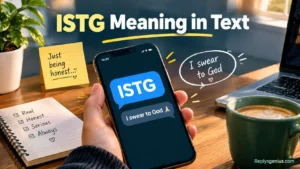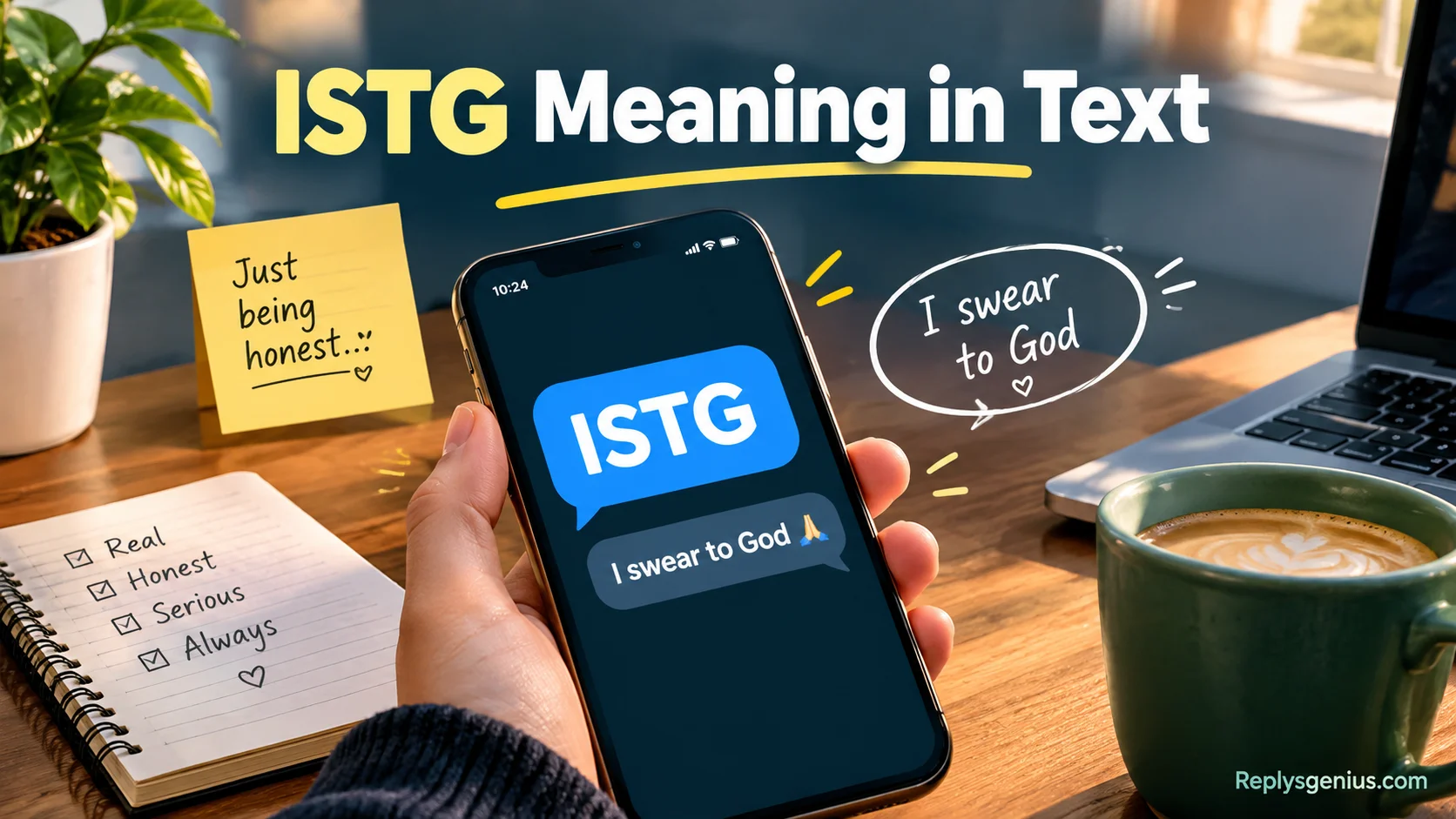
When you’re texting, scrolling through social media, or chatting online, you may see ISTG and wonder what it means. ISTG Meaning in Text usually stands for “I Swear to God,” an internet slang abbreviation that adds emphasis to a message. You’ll often find it on WhatsApp, Instagram, TikTok, Snapchat, and X. Its meaning depends on the situation, context, and conversational tone, so it can express honesty, frustration, excitement, or a playful reaction.
The easiest way to understand what ISTG means is to notice the words around ISTG and the overall tone of a conversation. In everyday chats, real chats, text messages, online conversations, social media posts, and TikTok comments, people use it to express honesty, frustration, excitement, surprise, and strong feelings. For example, “ISTG, I’m not lying” emphasizes honesty, while “ISTG, I told you yesterday!” may show frustration during funny arguments or serious conversations. Saying “ISTG, that movie was amazing” expresses enthusiasm and strong excitement. The same phrase can sound serious, funny, emotional, angry, or dramatic, depending on the emotional tone and conversational context. Whether you’re a student, social media user, gamer, or casual texter, learning internet terminology, online language, digital language, slang expressions, gaming slang, and social media slang can improve your digital communication skills and everyday social interactions.
One of the most common mistakes when using it yourself is assuming ISTG always shows anger or makes a serious promise. Its abbreviation meaning can change with the speaker’s personality, relationship, and communication style. Someone may use it for expressing frustration, while another person uses it for expressing excitement or playful communication with friends. When you’ve received a message containing ISTG, consider the surrounding words before deciding how to respond. This makes message interpretation easier and helps you understand the intended meaning. If a friend uses ISTG jokingly, a light response may fit; if the message sounds serious, respond calmly and directly. Learning this slang usage also helps you recognize digital conversations and online messages across social networking platforms. These habits make everyday texting clearer and help you reply naturally when someone says it.
What Does ISTG Mean in Text?
ISTG stands for “I swear to God.” It’s an informal texting abbreviation that people use to emphasize a statement, insist that something is true, or express a strong emotional reaction.
Think of ISTG as an emotional underline. It makes the words around it sound more intense or meaningful.
Consider these examples:
- “I didn’t take your charger.” This sounds like a straightforward statement.
- “ISTG, I didn’t take your charger.” This sounds more emphatic, as if the speaker really wants you to believe them.
- “ISTG, this charger disappears every day.” This sounds like an expression of frustration or playful exaggeration.
The abbreviation doesn’t have one fixed emotional tone. Instead, the surrounding words, punctuation, emojis, and relationship between the people help you understand its intended meaning.
What Does ISTG Stand For?
Each letter in ISTG represents a word from the original phrase.
| Letter | Word |
| I | I |
| S | Swear |
| T | To |
| G | God |
Together, these letters form “I swear to God.”
In everyday conversation, people sometimes use the full phrase to emphasize that they’re telling the truth or making a serious promise. In online chats, ISTG often serves the same purpose in a shorter form.
However, not every use represents a literal religious oath. Someone might write, “ISTG, my cat owns this house 😂” simply because their pet behaves like the boss of the family.
The meaning depends on how the sender uses the expression.
Is ISTG Slang or an Acronym?
ISTG is internet slang and is more precisely described as an initialism because people generally pronounce its letters individually rather than saying it as a regular word.
An acronym typically forms a word that people pronounce as a unit. An initialism uses the first letters of a phrase, with each letter spoken separately.
You might see ISTG written in several ways:
- ISTG — the uppercase form.
- istg — a casual lowercase version.
- Istg — a mixed-case version.
All three generally mean the same thing. The capitalization usually reflects personal typing style rather than a different definition.
What Does ISTG Mean in Different Contexts?
The most important thing to understand about ISTG is that its meaning depends on the situation. It can communicate several emotions without changing a single letter.
ISTG Meaning When Someone Is Angry or Frustrated
When someone feels annoyed, ISTG can express impatience or show that they’ve reached their limit.
For example:
“ISTG, if you leave your dishes here again, I’m not cleaning them.”
The sender sounds frustrated because they’re addressing a repeated problem. The phrase adds force to the complaint.
Friends also use ISTG for smaller annoyances:
“ISTG, this Wi-Fi stops working whenever I need it.”
The second example might be a genuine complaint or an exaggerated joke. The situation helps determine which one makes more sense.
How to recognize this meaning: Look for complaints, repeated problems, sharp wording, or statements that begin with “if you do that again.” These clues often indicate frustration.
ISTG Meaning When Someone Is Being Serious
ISTG can also emphasize honesty. Someone might use it when they think another person doubts their explanation.
For example:
“ISTG, I sent you the assignment yesterday.”
The sender wants the recipient to believe the claim. The abbreviation strengthens the statement, much like saying, “I’m being completely serious.”
Another example:
“I didn’t tell anyone your secret, ISTG.”
Here, ISTG reinforces a denial.
However, remember that using ISTG doesn’t prove a statement is true. It only tells you that the person is emphasizing what they’re saying. Whether you believe the claim depends on the situation and the evidence available.
ISTG Meaning When Someone Is Surprised
People often use ISTG to react to something unexpected, shocking, or difficult to believe.
For example:
“ISTG, you actually won the competition?”
The sender sounds surprised and may need a moment to process the news.
You might also see:
- “ISTG, that ending caught me off guard.”
- “ISTG, I never expected her to say that.”
- “ISTG, how did you finish the entire series in one night?”
In these examples, ISTG adds emphasis to the speaker’s reaction. It can communicate disbelief without expressing anger.
ISTG Meaning as a Promise or Assurance
Sometimes, ISTG strengthens a promise or an assurance.
For example:
“ISTG, I’ll call you when I get home.”
The sender emphasizes their intention to call. The phrase makes the promise sound more forceful.
Another example:
“ISTG, I’ll pay you back on Friday.”
This sounds like the speaker wants the other person to take the commitment seriously.
Still, ISTG isn’t a guarantee. If someone makes a promise and repeatedly breaks it, the abbreviation doesn’t change that pattern. Pay attention to actions as well as words.
ISTG Meaning as a Joke or Playful Exaggeration
Not every ISTG message carries serious emotion. Friends often use it to make ordinary situations sound dramatic.
For example:
“ISTG, if my phone dies at 1% again, I’m buying a new life.”
The statement is exaggerated for humor. The sender probably isn’t making a serious threat against their phone.
Other playful examples include:
- “ISTG, you spend longer choosing a movie than watching one.”
- “ISTG, my dog thinks he pays the rent.”
- “ISTG, this homework has its own family tree.”
If the conversation already includes jokes, laughing emojis, or playful teasing, ISTG may simply add comic emphasis.
What Does ISTG Mean on Snapchat, TikTok, and Instagram?
ISTG generally means “I swear to God” across social platforms. The main difference is where people use it and what they’re responding to.
ISTG Meaning on Snapchat
On Snapchat, ISTG can appear in private messages, quick replies, and conversations between friends.
For example:
“ISTG, I sent you that snap five minutes ago 😂”
The sender might be teasing a friend who hasn’t replied. Depending on their relationship, the message could sound playful or annoyed.
Another example is:
“ISTG, you look so different in that picture.”
This could express surprise or emphasize an observation. The surrounding conversation determines whether the comment sounds positive, neutral, or critical.
ISTG Meaning on TikTok
TikTok users may write ISTG in comments, captions, or replies to videos. It often emphasizes a strong reaction to something funny, relatable, surprising, or frustrating.
Examples include:
- “ISTG, this video describes my entire life.”
- “ISTG, I wasn’t ready for that ending.”
- “ISTG, why is this sound stuck in my head?”
In these cases, ISTG helps communicate the intensity of the reaction. It doesn’t have a special TikTok-only definition.
ISTG Meaning on Instagram
On Instagram, ISTG appears in direct messages, Reels comments, Stories replies, and casual captions.
For example:
“ISTG, this picture came out perfect.”
Here, the sender is emphasizing a positive opinion.
A friend might also comment:
“ISTG, you post the best food pictures.”
That sounds like an enthusiastic compliment. However, the abbreviation alone doesn’t tell you whether a message is sincere, sarcastic, or flirtatious. Read the entire comment before deciding.
ISTG Meaning in WhatsApp and Group Chats
WhatsApp conversations and group chats provide another common setting for ISTG.
For example:
“ISTG, we agreed to meet at six.”
The sender might be reminding the group about a plan while expressing mild frustration.
In a different conversation, someone could write:
“ISTG, nobody in this group can keep a secret 😂”
The laughing emoji and joking context may make the message playful rather than accusatory.
The platform doesn’t change the basic definition. What matters is the conversation surrounding the abbreviation.
What Does ISTG Mean From a Girl or a Guy?
The meaning of ISTG doesn’t change based on the sender’s gender. A girl, guy, or anyone else can use it to express frustration, sincerity, surprise, humor, or emphasis.
Still, the context of a personal conversation can affect how you interpret it.
What Does ISTG Mean When a Girl Texts You?
If a girl sends you ISTG, consider what she says alongside it.
For example:
“ISTG, you’re so funny 😂”
This likely expresses amusement or emphasizes a compliment.
On the other hand:
“ISTG, you never listen when I talk.”
This sounds frustrated because the message addresses a problem.
If you’re texting someone you like, ISTG may appear in playful or affectionate messages. For example, “ISTG, you make me laugh too much” could be a friendly compliment or flirtatious teasing.
However, ISTG alone doesn’t mean she likes you romantically. Look at the broader conversation and how she communicates with you.
What Does ISTG Mean When a Guy Texts You?
A guy may use ISTG for the same reasons.
For example:
“ISTG, that was the best game I’ve ever played.”
This communicates excitement or enthusiasm.
Alternatively:
“ISTG, I didn’t send that message.”
This emphasizes a denial.
In a playful conversation, he might write:
“ISTG, you always steal my fries.”
The sender could be teasing you rather than expressing genuine anger.
As with any text abbreviation, don’t assign a romantic meaning without additional context. The actual words and the relationship between the people provide better clues than gender alone.
How to Tell Whether ISTG Is Serious, Funny, or Angry
Text messages don’t include vocal tone or facial expressions. As a result, a short abbreviation can be difficult to interpret without context.
Fortunately, a few clues can help you make a more informed guess.
| Clue | Possible interpretation | Example |
| A clear denial | Emphasizing honesty | “ISTG, I didn’t take it.” |
| A complaint about repeated behavior | Frustration | “ISTG, this keeps happening.” |
| A laughing emoji | Playful emphasis | “ISTG, you’re ridiculous 😂” |
| An unexpected event | Surprise or disbelief | “ISTG, that really happened?” |
| A promise about future action | Assurance | “ISTG, I’ll be there.” |
| Sharp wording during an argument | Possible anger | “ISTG, stop doing that.” |
These are clues, not guaranteed rules. Some people use emojis when they’re genuinely upset, while others write short messages even when they’re joking.
Signs ISTG Is Serious
A serious ISTG message often appears when someone wants to clarify a fact, defend themselves, or reassure another person.
For example:
“ISTG, I wasn’t ignoring you. I was in class.”
The sender provides an explanation and emphasizes that it’s true.
If the issue matters, respond to the actual concern rather than focusing only on the abbreviation.
Signs ISTG Is Used as a Joke
Playful ISTG messages often contain obvious exaggeration, teasing, or humor.
For example:
“ISTG, if you eat my last cookie, we’re no longer friends 😂”
If the relationship is friendly and the situation is harmless, the sender may be joking rather than threatening to end the friendship.
However, don’t assume every dramatic message is a joke. If you’re unsure, asking a simple question can prevent a misunderstanding.
Signs ISTG Expresses Anger
ISTG may sound angry when the sender uses it during an argument or follows it with a direct complaint.
For example:
“ISTG, I’ve explained this three times already.”
This wording suggests impatience. The sender may feel unheard or frustrated.
When a message sounds genuinely upset, avoid responding with more sarcasm. A calm reply can help clarify the issue before the conversation escalates.
ISTG Meaning in Real Text Conversations
The easiest way to understand ISTG is to see how it works in everyday exchanges. The following examples show how the abbreviation can change meaning depending on the situation.
| Situation | Example message | What it means |
| Frustration | “ISTG, this assignment never ends.” | I’m getting frustrated. |
| Surprise | “ISTG, you won the whole thing?” | I’m genuinely surprised. |
| Honesty | “ISTG, I didn’t touch your phone.” | I’m insisting that I’m telling the truth. |
| Promise | “ISTG, I’ll call tonight.” | I’m emphasizing my promise. |
| Humor | “ISTG, my cat runs this house.” | I’m joking or exaggerating. |
| Disbelief | “ISTG, you watched that movie five times?” | I can’t believe it. |
| Excitement | “ISTG, this song is incredible.” | I feel strongly about how good it is. |
| Impatience | “ISTG, why is this taking so long?” | I’m getting annoyed. |
A Short Case Study: One Abbreviation, Two Different Emotions
Imagine that Alex and Jordan are texting about a group project.
Conversation A:
Alex: “Did you finish the slides?”
Jordan: “ISTG, I finished them last night.”
Here, Jordan uses ISTG to emphasize that the slides are already finished. If Alex doubted the claim, Jordan may be trying to reassure them.
Conversation B:
Alex: “You forgot to upload the slides again.”
Jordan: “ISTG, this website is driving me crazy.”
In the second conversation, Jordan expresses frustration with the upload process. The abbreviation adds emotional force to the complaint.
The lesson is simple: don’t interpret ISTG in isolation. Read the words around it and consider what happened before the message.
How to Reply to ISTG in Text
The best response depends on what the sender means. You don’t need to use ISTG yourself to reply naturally.
How to Reply When Someone Is Frustrated
If someone sounds annoyed, acknowledge the issue rather than making fun of their reaction.
Possible replies include:
- “I get why you’re annoyed.”
- “Yeah, that sounds frustrating.”
- “Hopefully, it gets sorted out soon.”
- “Let’s figure out what happened.”
- “I understand. That would bother me too.”
Example:
Friend: “ISTG, this app keeps crashing.”
You: “That’s so annoying. Have you tried restarting it?”
This response recognizes the frustration and offers practical help.
How to Reply When Someone Is Being Serious
If someone uses ISTG to insist that they’re telling the truth, respond to the situation rather than the abbreviation.
Possible replies include:
- “Okay, I hear you.”
- “Thanks for explaining.”
- “I understand what you’re saying.”
- “All right, let’s clear this up.”
- “I appreciate you being honest with me.”
Choose your response based on the situation. If the conversation involves a serious disagreement, avoid pretending that the abbreviation proves the sender’s claim.
How to Reply When Someone Is Joking
When the context is clearly playful, a lighthearted response can keep the conversation fun.
Try these replies:
- “LOL, calm down.”
- “You’re so dramatic 😂”
- “I can’t even argue with that.”
- “Okay, fair enough.”
- “Not you acting like it’s the end of the world.”
- “Honestly, you’re not wrong.”
Example:
Friend: “ISTG, you take three hours to choose a movie.”
You: “And somehow we still end up watching yours 😂”
The reply matches the playful tone without turning the conversation into an argument.
How to Reply When Someone Makes a Promise
If someone uses ISTG to emphasize a promise, your response can be simple and direct.
For example:
- “Okay, I’ll hold you to that.”
- “Sounds good. Thanks!”
- “All right, let me know.”
- “I appreciate it.”
- “Okay, I hope it works out.”
For important commitments, focus on the actual plan rather than the strength of the wording.
ISTG vs. Similar Text Abbreviations
ISTG isn’t the only abbreviation people use to emphasize a message. Several other expressions communicate honesty, agreement, or strong feelings, but each has a slightly different purpose.
| Slang | Full form | Common meaning |
| ISTG | I swear to God | Emphasis, sincerity, frustration, or surprise |
| ONG | On God | Emphasis, agreement, or sincerity |
| FR | For real | Agreement, seriousness, or emphasis |
| NGL | Not gonna lie | Introducing a candid opinion |
| TBH | To be honest | Expressing an honest opinion |
| ATP | At this point | Referring to a current situation or stage |
ISTG vs. ONG
ISTG means “I swear to God,” while ONG means “on God.”
Both expressions can emphasize sincerity or strong feelings. However, they’re not always interchangeable because the wording and conversational role differ.
Examples:
- “ISTG, I didn’t take your food.” This emphasizes a denial.
- “ONG, that movie was amazing.” This strongly emphasizes an opinion.
Both are informal expressions, and their exact tone depends on context.
ISTG vs. FR
FR stands for “for real.” People use it to express agreement, confirm sincerity, or emphasize a point.
For example:
“FR, that test was difficult.”
This communicates agreement or a genuine opinion.
Compare it with:
“ISTG, that test was difficult.”
The second version adds stronger personal emphasis. It may sound more dramatic or emotional.
ISTG vs. NGL
NGL means “not gonna lie.” It commonly introduces an honest opinion or admission.
For example:
“NGL, I didn’t like the ending.”
The sender introduces a candid opinion.
By contrast:
“ISTG, that ending made no sense.”
The sender emphasizes their reaction more forcefully.
Both abbreviations can appear in the same conversation, but they serve different purposes.
Is ISTG Rude, Offensive, or Inappropriate?
ISTG isn’t automatically rude. Friends often use it casually, and many messages containing it are playful or harmless.
However, the phrase can sound confrontational when someone uses it during an argument or directs it at another person angrily.
For example:
“ISTG, stop interrupting me.”
This message sounds firm and possibly irritated. The tone comes from the command and the situation, not simply from the abbreviation.
There’s another consideration: the phrase includes a reference to God. Some people view swearing by God as religiously significant, while others use the expression casually. If you know that someone finds such language offensive, choose a more neutral expression.
You can replace ISTG with:
- “Seriously.”
- “I promise.”
- “I’m telling the truth.”
- “Honestly.”
- “I really mean it.”
In professional conversations, it’s usually better to avoid ISTG. A message such as “ISTG, this deadline is impossible” can sound unprofessional or overly emotional.
A clearer alternative would be:
“Given the current workload, meeting this deadline may be difficult.”
The goal isn’t to avoid all informal language. It’s to choose wording that fits the audience and situation.
Is ISTG Still Used in 2026?
ISTG remains a recognizable abbreviation in online slang and informal digital communication. Current internet-slang explainers continue to document its meaning and usage, including its use to express seriousness, exasperation, and surprise. See Dictionary.com’s slang and acronym resources for related language references.
People use ISTG because it offers a quick way to emphasize a message without typing the full phrase. It also fits the expressive style of casual chats, comments, and direct messages.
However, it’s important not to confuse visibility with a measurable popularity ranking. The fact that you see ISTG online doesn’t prove that every age group or social platform uses it at the same rate.
The abbreviation also doesn’t belong exclusively to one generation. People pick up internet slang from friends, online communities, entertainment, and everyday conversations.
If you encounter ISTG in 2026, the most useful approach is still to understand its basic meaning and interpret the surrounding context.
Common Mistakes to Avoid When Using ISTG
Even familiar internet slang can lead to misunderstandings when people assume too much.
Here are some common mistakes to avoid:
- Assuming ISTG always means anger. It can also express humor, excitement, sincerity, or surprise.
- Treating ISTG as proof of honesty. The abbreviation emphasizes a claim but doesn’t verify it.
- Assuming it signals romantic interest. A person can use ISTG with friends, family, classmates, or romantic partners.
- Using it in every situation. Formal messages and sensitive conversations often call for clearer, more neutral wording.
- Confusing it with ONG or FR. These expressions overlap in some situations but don’t have identical meanings.
- Ignoring the surrounding conversation. A playful message can sound harsh when read without its context.
- Assuming the capitalization changes the meaning. ISTG, istg, and Istg generally mean the same thing.
The biggest mistake is reading too much into four letters. Consider the complete message, the relationship, and the situation before deciding what someone intended.
FAQs
1. What does ISTG mean in text?
ISTG stands for “I Swear to God.” People use this texting abbreviation to emphasize a statement, express honesty, or show strong feelings during online conversations.
2. Is ISTG rude or offensive?
ISTG isn’t usually considered rude, but it can sound intense depending on the context and tone. Some people use it casually with friends, while others use it during serious conversations.
3. What does ISTG mean on Snapchat and TikTok?
On Snapchat and TikTok, ISTG usually means “I Swear to God.” Users add it to messages, comments, and posts to express frustration, excitement, surprise, or honesty.
4. How should I reply when someone says ISTG?
Your reply depends on the conversation. If someone is joking, you can respond playfully. If they’re serious, answer calmly. For example, you could say, “I believe you,” or “Okay, I understand.”
5. Can ISTG have different meanings depending on the situation?
Yes, the meaning of ISTG can feel different depending on the speaker’s intention. Although it generally stands for “I Swear to God,” it can express sincerity, annoyance, excitement, or humor.
Conclusion
Understanding ISTG meaning in text makes online conversations easier to follow. This popular internet slang abbreviation stands for “I Swear to God” and appears on platforms like WhatsApp, Instagram, Snapchat, TikTok, and X. People use it to emphasize their words, express honesty, or show emotions such as frustration, excitement, and surprise. The best way to understand its intended meaning is to pay attention to the context and the speaker’s tone.
Whether you’re chatting with friends, reading social media comments, or playing online games, recognizing ISTG can improve your digital communication skills. You don’t need to use every slang term you encounter, but knowing common abbreviations helps you understand messages more naturally. When someone sends you ISTG, consider the surrounding words before replying so your response matches the conversation.