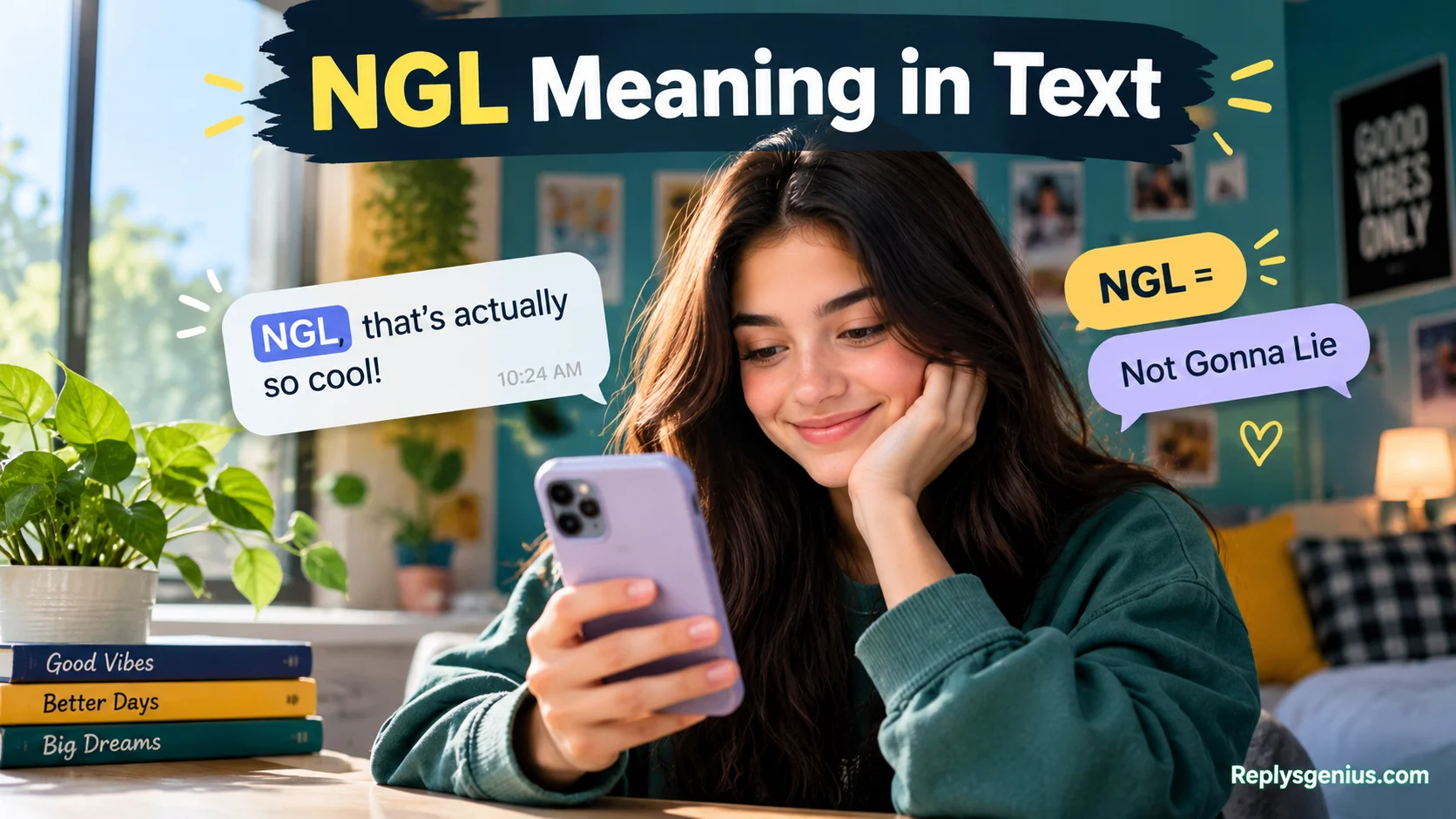
Have you seen NGL in text messages or social media? NGL Meaning in Text explains how this popular acronym introduces honesty, opinions, and personal thoughts.
In everyday digital communication, NGL stands for “Not Gonna Lie.” People use it across Instagram, Snapchat chats, TikTok comments, and Discord conversations to share a candid statement, an honest opinion, or a personal confession. For example, a friend might text, “NGL, that movie was amazing!” The phrase creates a casual conversational tone and can make online conversations feel more genuine. Understanding this internet slang helps you interpret messages, recognize social cues, and follow modern texting habits without misunderstanding someone’s meaning.
NGL can also introduce personal feelings, straightforward opinions, or an admission that feels slightly vulnerable. Similar abbreviations include TBH (“To Be Honest”) and IMO (“In My Opinion”), which serve related but different purposes. While NGL often introduces a candid admission, TBH emphasizes honesty, and IMO signals a personal viewpoint. Learning these common abbreviations, their acronym meanings, and their usage improves your understanding of American slang, digital culture, and informal communication. Whether you’re messaging friends or reading social media comments, knowing when and how to use NGL helps you communicate clearly.
What Does NGL Mean in Text?
NGL stands for “not gonna lie.” It’s an informal abbreviation people use in text messages, online chats, and social media conversations. The phrase is a shorter way of saying “not going to lie,” and it often serves the same conversational purpose as “honestly” or “to be honest.”
Imagine your friend asks whether you enjoyed a new restaurant. You might reply, “NGL, the food was better than I expected.” You’re sharing your genuine opinion rather than giving a polite answer just to please someone.
The abbreviation can introduce several kinds of statements, including:
- Honest opinions: “NGL, that book was surprisingly good.”
- Personal admissions: “NGL, I forgot about our meeting.”
- Compliments: “NGL, your new haircut looks great.”
- Criticism: “NGL, the ending felt rushed.”
- Humorous observations: “NGL, my bed is winning the argument today.”
The important detail is that NGL doesn’t change the basic meaning of the sentence. Instead, it adds a conversational signal that frames the statement as honest, personal, or slightly unexpected.
NGL Meaning at a Glance
| Detail | Explanation |
| Full form | Not gonna lie |
| Expanded form | Not going to lie |
| Type | Informal internet and texting abbreviation |
| Main purpose | Introduce a candid opinion, admission, or reaction |
| Common tone | Casual, sincere, playful, or blunt |
| Typical settings | Text messages, social media, online chats, and group conversations |
| Similar expressions | Honestly, to be honest, TBH, and I can’t lie |
| Formality | Best suited to informal communication |
Cambridge Dictionary also defines NGL as an informal abbreviation used in social media and text messages, including when someone admits something embarrassing or introduces criticism.
What Does NGL Mean in Texting and Chat?
In texting, NGL works as a quick way to introduce a thought without typing the entire phrase “not gonna lie.” People often use it when they want to sound natural, direct, or emotionally open.
For instance, a friend might text, “NGL, I thought you were mad at me yesterday.” The abbreviation signals a personal feeling that the sender may have hesitated to express directly. It makes the sentence sound conversational rather than overly serious.
Consider another exchange:
Alex: Did you like the presentation?
Jordan: NGL, I was nervous at first, but it went really well.
Jordan uses NGL to introduce an honest reflection. The abbreviation adds a little personality to the message without changing its meaning.
You may also see NGL in group chats, gaming conversations, school discussions, and casual workplace messaging. Its function stays mostly the same across these settings, although the tone depends on the people involved.
Common NGL Text Message Examples
| Text message | What it means |
| “NGL, I’m exhausted.” | The sender is admitting how tired they feel. |
| “NGL, you were right.” | The sender acknowledges that the other person had a good point. |
| “NGL, that was awkward.” | The sender honestly thinks the situation felt uncomfortable. |
| “NGL, I miss those days.” | The sender is sharing a sincere feeling of nostalgia. |
| “NGL, I didn’t expect that.” | The sender is expressing genuine surprise. |
| “NGL, this song is addictive.” | The sender really enjoys the song. |
A useful tip: Read the entire message before interpreting NGL. The abbreviation signals the speaker’s intended tone, but the words that follow reveal what they’re actually trying to communicate.
How Is NGL Used in Different Situations?
NGL is flexible because people can use it before almost any personal observation. However, the meaning behind a message becomes clearer when you look at the situation and the relationship between the people chatting.
NGL for Honest Opinions
People often use NGL when they want to share an opinion without making it sound like a formal review. It works well for movies, music, food, games, school experiences, and everyday decisions.
Example:
NGL, I thought the first episode was boring, but the second one was great.
Here, the sender gives a balanced opinion. NGL introduces the personal judgment, while the rest of the sentence explains how their opinion changed.
You might also see messages like these:
- “NGL, that restaurant is overrated.”
- “NGL, this album deserves more attention.”
- “NGL, your idea makes a lot of sense.”
- “NGL, I enjoyed the book more than the movie.”
People don’t need to agree with these opinions. NGL simply signals that the writer is presenting a candid view.
NGL for Compliments
NGL can make a compliment sound spontaneous and personal. Instead of offering a polished statement, the sender appears to share a thought that came naturally to mind.
Example:
NGL, you look amazing in that picture.
The sender is expressing admiration and emphasizing that the compliment is sincere. Depending on the relationship, the message could sound friendly, affectionate, or flirtatious.
Other examples include:
- “NGL, you have a great sense of humor.”
- “NGL, your presentation was impressive.”
- “NGL, that outfit suits you perfectly.”
- “NGL, your voice sounds beautiful.”
Keep in mind that NGL doesn’t prove the compliment is genuine. It only frames the statement that way. The sender’s behavior and the broader conversation offer better clues about their intentions.
NGL for Confessions and Admissions
Sometimes people use NGL before admitting something embarrassing, awkward, or difficult to say. The abbreviation can make the admission feel less formal and easier to share.
Example:
NGL, I forgot to submit the assignment.
This message acknowledges a mistake directly. The sender doesn’t make a long excuse; they simply admit what happened.
More examples include:
- “NGL, I was too nervous to ask.”
- “NGL, I didn’t understand the instructions.”
- “NGL, I ate the last slice of pizza.”
- “NGL, I checked my phone during the movie.”
These statements can be serious or playful. Forgetting an important deadline carries a different weight from admitting that you ate the last cookie, even though both messages use the same abbreviation.
NGL for Criticism
NGL also appears before negative opinions or complaints. People may use it to make criticism sound more conversational or less formal.
Example:
NGL, the instructions were confusing.
The sender is expressing dissatisfaction without writing a lengthy complaint. The abbreviation may soften the delivery slightly, but it doesn’t remove the criticism itself.
Consider these examples:
- “NGL, that joke wasn’t funny.”
- “NGL, the service could have been better.”
- “NGL, I expected more from the final episode.”
- “NGL, your comment came across as rude.”
Remember: NGL isn’t a magic shield against hurt feelings. A blunt statement can still offend someone even when you introduce it with an honesty marker. If the subject is sensitive, respectful wording matters more than slang.
NGL for Jokes and Sarcasm
People also use NGL to set up a funny observation, an exaggerated complaint, or a sarcastic remark. In these cases, the humor comes from the statement rather than the abbreviation itself.
Example:
NGL, I need a vacation from my vacation.
The speaker probably isn’t making a serious complaint about needing time off. Instead, they’re joking about feeling tired even after taking a break.
Here are a few more examples:
- “NGL, my productivity disappears the moment I open social media.”
- “NGL, I deserve an award for ignoring my alarm.”
- “NGL, choosing what to eat is my hardest decision today.”
- “NGL, I ran out of energy before the day even started.”
The key is context. A laughing emoji, an exaggerated statement, or an established joking relationship can help readers recognize the humor.
What Does NGL Mean on Social Media?
On social media, NGL generally means “not gonna lie,” just as it does in ordinary texting. Users place it in comments, captions, direct messages, and posts when they want to express an opinion or reaction.
The exact style varies by platform, but the basic meaning stays consistent.
NGL on Instagram
On Instagram, people may use NGL in direct messages, comments, Stories, or captions. It often appears alongside compliments, opinions about photos, and reactions to personal updates.
Examples:
- “NGL, this picture turned out perfectly.”
- “NGL, your travel photos make me want to book a trip.”
- “NGL, that outfit is a whole vibe.”
There is one important distinction: NGL can also refer to the NGL anonymous messaging app. If someone shares an NGL link and asks followers to send questions or confessions, they may be referring to the service rather than using the abbreviation in a sentence.
On TikTok, NGL can appear in comments, video captions, and conversations about trends. People use it to introduce reactions to videos, music, opinions, and relatable experiences.
Examples:
- “NGL, this trend is actually fun.”
- “NGL, I watched this video five times.”
- “NGL, the original version was better.”
The abbreviation helps keep comments short and casual. It doesn’t automatically indicate a particular trend, challenge, or community.
NGL on Snapchat
Snapchat conversations often involve quick reactions, casual updates, and personal messages. NGL fits naturally into that style of communication.
Examples:
- “NGL, that snap made me laugh.”
- “NGL, I thought you were going to cancel.”
- “NGL, today was actually pretty good.”
A message containing NGL may be friendly, affectionate, or critical. The surrounding conversation usually provides the clearest interpretation.
NGL on X and Other Online Communities
People may use NGL on X, Reddit, Discord, gaming platforms, and other online communities to share opinions or react to discussions.
For example:
NGL, the update fixed one problem but created three more.
The writer uses NGL to introduce a direct opinion about a software update. In a gaming chat, the same abbreviation might introduce a comment about a match or teammate.
Across these platforms, the central meaning remains “not gonna lie.” You don’t need to memorize a separate definition for every social network.
What Does NGL Mean From a Guy or Girl?
If a guy or girl sends you NGL, the abbreviation itself still means “not gonna lie.” It doesn’t have a different definition based on the sender’s gender.
What changes is the message that follows and the relationship between the two people.
For example:
“NGL, you looked really good today.”
This could be a straightforward compliment from a friend. It could also be flirtatious if the sender has shown romantic interest or if the conversation already has a playful tone.
Compare it with this message:
“NGL, you always make group projects less stressful.”
Here, the sender may simply be expressing appreciation for your personality or teamwork.
How to Interpret NGL in a Flirty Text
Look at the complete conversation instead of treating NGL as proof of romantic interest. A compliment can be flirtatious, but it can also be friendly.
Useful context clues include:
- The wording: Is the message personal or focused on a shared activity?
- The conversation: Does the sender regularly flirt or offer compliments?
- The relationship: Are you close friends, new acquaintances, or potential romantic partners?
- The follow-up: Does the sender continue the conversation or show interest in getting to know you?
For example, “NGL, I was hoping you’d text me” suggests personal interest more strongly than “NGL, that was a good game.”
Even then, context isn’t certainty. If you want to know someone’s intentions, a direct and respectful conversation is more reliable than trying to decode three letters.
What Does NGL Mean at the Beginning or End of a Sentence?
NGL can appear at the beginning or end of a sentence. Its basic meaning doesn’t change, although its placement can affect how the message flows.
NGL at the Beginning of a Sentence
When NGL appears first, it introduces the thought that follows. This placement is common because it prepares the reader for an opinion or admission.
Examples:
- “NGL, I really enjoyed that concert.”
- “NGL, I wasn’t expecting your message.”
- “NGL, this is harder than it looks.”
In each example, NGL works much like “honestly.” It sets the tone before the main statement.
NGL at the End of a Sentence
When NGL appears at the end, it can function like a final emphasis. The writer states an opinion first and then adds NGL to reinforce its candid or personal nature.
Examples:
- “That was a long day, ngl.”
- “Your explanation helped a lot, ngl.”
- “I could eat pizza every day, ngl.”
This placement can make the message feel like a casual afterthought. It doesn’t necessarily mean the statement is more truthful than one with NGL at the beginning.
Does Capitalization Matter?
No. NGL, ngl, and Ngl usually communicate the same thing in casual digital conversations.
| Form | Typical impression |
| NGL | Clear and slightly emphatic |
| ngl | Casual and relaxed |
| Ngl | A capitalization choice, often influenced by typing habits |
These are stylistic differences, not separate definitions. Most readers understand all three forms from context.
Read More: ISTG Meaning in Text: What It Means and How to Use?
How Do You Reply to NGL in a Text?
When someone sends you a message containing NGL, you don’t need to reply to the abbreviation itself. Respond to the opinion, compliment, confession, or question that follows it.
Your answer should match the conversation’s tone. A playful message invites a different response from a serious admission or an uncomfortable comment.
Replies to NGL Compliments
If someone writes, “NGL, you look great today,” you can accept the compliment without making the conversation awkward.
Possible replies include:
- “Thank you! That’s really sweet of you.”
- “Aw, I appreciate that!”
- “Glad you think so!”
- “NGL, you’re looking pretty good too.”
The last response returns the compliment and can sound flirtatious, depending on your relationship.
Replies to NGL Confessions
Suppose your friend texts, “NGL, I forgot about our plans.”
You could reply with:
- “Haha, it happens. Are we still meeting?”
- “Thanks for being honest. Let’s reschedule.”
- “I had a feeling something came up!”
- “Next time, set a reminder!”
Choose a response that fits the situation. If the forgotten plans caused a real problem, you can explain your feelings without turning the conversation into an argument.
Replies to NGL Opinions
When someone shares an honest opinion, you can agree, disagree politely, or ask them to explain.
Example:
Friend: “NGL, I didn’t like the movie.”
You: “Really? What didn’t you like about it?”
Other natural replies include:
- “Fair enough. Everyone has different tastes.”
- “I actually enjoyed it!”
- “I can see why you’d feel that way.”
- “What would you have changed?”
These responses keep the conversation moving without suggesting that everyone must share the same opinion.
Replies to NGL Jokes
If someone uses NGL to make a joke, a playful response can keep the exchange lively.
Example:
Friend: “NGL, my bed is my favorite place.”
You: “Same. We should start a fan club.”
You could also say, “Honestly, no argument here,” or “Your bed deserves an award.”
The best reply doesn’t need to be clever every time. A simple laugh or a relevant comment can be enough.
Replies to Serious NGL Messages
Sometimes NGL introduces a personal concern, such as “NGL, I’ve been feeling left out lately.”
Don’t brush off a serious message with a joke. Instead, acknowledge the person’s feelings and invite them to share more if they want.
For example:
“I’m sorry you’ve been feeling that way. Do you want to talk about what’s been happening?”
This kind of response shows care without assuming you already understand the problem.
NGL vs. TBH, ICL, FR, and No Cap
NGL belongs to a wider group of informal expressions people use to signal honesty, agreement, or sincerity. Some alternatives have nearly the same meaning, while others serve a slightly different purpose.
Understanding these differences helps you choose the right phrase for the conversation.
| Slang | Full form or meaning | Typical use | Example |
| NGL | Not gonna lie | Introducing a candid opinion or admission | “NGL, that was impressive.” |
| TBH | To be honest | Introducing an honest opinion or assessment | “TBH, I expected more.” |
| ICL | I can’t lie | Emphasizing a candid thought | “ICL, that song is catchy.” |
| FR | For real | Showing agreement, seriousness, or emphasis | “FR, that was hilarious.” |
| No cap | No lie; no exaggeration | Emphasizing that a claim is genuine | “No cap, this is the best pizza I’ve tried.” |
| Honestly | Honestly | Expressing an opinion or sincere reaction | “Honestly, I enjoyed it.” |
These expressions overlap, but they aren’t perfect substitutes in every situation.
NGL vs. TBH
NGL means “not gonna lie,” while TBH means “to be honest.” Both often introduce personal opinions, admissions, or criticism.
For example:
- NGL: “NGL, I was nervous before the interview.”
- TBH: “TBH, I was nervous before the interview.”
Both sentences communicate the same basic idea. The choice usually comes down to personal style and the flow of the conversation.
NGL vs. ICL
ICL stands for “I can’t lie.” Like NGL, it often introduces a candid statement.
For example:
- “NGL, that was a great performance.”
- “ICL, that was a great performance.”
Both sound natural in informal conversations. The preferred expression may depend on the writer’s usual vocabulary or online community.
NGL vs. FR
FR stands for “for real.” People use it to express agreement, emphasize a point, or show that they mean what they say.
Compare these messages:
- “NGL, that exam was difficult.” — Introduces a candid opinion.
- “FR, that exam was difficult.” — Emphasizes the statement or agrees with someone else’s view.
The difference is subtle because both can express sincerity. However, FR often works as a reaction to something another person has said.
NGL vs. No Cap
“No cap” is an informal expression used to suggest that a statement is genuine or not exaggerated.
For example:
- “NGL, this is my favorite song.”
- “No cap, this is my favorite song.”
Both can emphasize sincerity, but No cap can sound more emphatic or playful in some contexts.
Quick tip: If you want a simple, widely understandable alternative to NGL, use “honestly” or “to be honest.” These expressions work in more situations and don’t rely on slang familiarity.
Is NGL Formal or Informal?
NGL is informal internet slang. It works best in casual communication, where abbreviated expressions and conversational wording feel natural.
You can use it with friends, relatives, familiar classmates, and people who regularly use similar slang. It may also fit an informal workplace group chat if your team communicates casually.
However, NGL usually doesn’t belong in formal emails, academic essays, official letters, or professional reports. In those settings, writing out your thought clearly is more appropriate.
Consider the difference:
Casual message:
NGL, I think we should change the presentation design.
Professional version:
Honestly, I think we should revise the presentation design.
More formal version:
I recommend revising the presentation design to improve clarity.
Each version communicates a similar idea, but the wording suits a different audience.
When Should You Use NGL?
NGL is a reasonable choice when:
- You’re chatting with friends.
- You’re sharing an opinion in a casual online discussion.
- You’re giving a compliment in a relaxed conversation.
- You’re admitting a small mistake.
- You’re making a playful observation.
When Should You Avoid NGL?
Consider using standard wording instead when:
- You’re writing to a client you don’t know well.
- You’re submitting an academic assignment.
- You’re sending a formal complaint.
- You’re discussing a sensitive workplace issue.
- You’re communicating with someone who may not understand internet slang.
The issue isn’t that NGL is inherently wrong. It’s that good communication depends on your audience and setting. A phrase that sounds natural in a group chat might feel out of place in a formal business email.
Does NGL Have Other Meanings?
In ordinary texting and social media conversations, NGL generally means “not gonna lie.” However, the same letters can refer to something else when the subject changes.
Two distinctions are particularly useful.
NGL as an Anonymous Messaging App
NGL is also the name of a social messaging service that lets users receive messages through a shared link. Someone may post that link on a social media profile or Story and invite others to send messages.
For example, a person might write, “Send me an NGL!” alongside a link. In that context, they’re probably referring to the app rather than using the phrase “not gonna lie.”
You can learn more through.
NGL in the Energy Industry
In energy-related discussions, NGL can stand for natural gas liquids. This is a technical term for a group of hydrocarbons separated from natural gas or associated processing streams.
Natural gas liquids include substances such as ethane, propane, normal butane, isobutane, and natural gasoline. These materials have industrial and commercial uses, including fuel production and petrochemical manufacturing.
The U.S. Energy provides further information about natural gas terminology.
This meaning is unlikely in an ordinary text from a friend. However, it may appear in an industry report, an energy-market article, or a professional discussion about natural gas processing.
How Can You Tell Which Meaning Applies?
Use the surrounding words to identify the intended meaning.
| Context | Likely meaning |
| “NGL, I loved that movie.” | Not gonna lie |
| “Drop your NGL link.” | The anonymous messaging app |
| “The report covers NGL production.” | Natural gas liquids |
| “NGL, I need some sleep.” | Not gonna lie |
Context usually resolves the confusion immediately. You don’t need to assume that every appearance of NGL refers to internet slang.
Common Mistakes to Avoid When Using NGL
NGL is simple to understand, but a few common mistakes can make your message confusing or awkward.
Assuming NGL Proves Someone Is Telling the Truth
When someone writes NGL, they’re presenting their statement as honest. The abbreviation doesn’t independently verify the claim.
For example, “NGL, I never saw your message” tells you what the sender says happened. It doesn’t prove whether they actually missed the message.
Treat NGL as a conversational cue rather than evidence.
Using NGL in Every Message
Repeating NGL too often can make your writing sound predictable. You don’t need to introduce every opinion with an honesty marker.
Compare these examples:
- Repetitive: “NGL, I’m tired. NGL, I’m hungry. NGL, I need coffee.”
- More natural: “I’m tired, hungry, and desperately need coffee.”
The second version communicates the same idea without unnecessary repetition.
Assuming NGL Always Introduces Bad News
NGL can precede criticism, but it also introduces compliments, positive reactions, confessions, and jokes.
For example, “NGL, you did an amazing job” is positive. The abbreviation doesn’t automatically signal a complaint.
Misreading a Compliment as Flirting
A message like “NGL, your presentation was great” is usually a compliment about someone’s work. It doesn’t automatically suggest romantic interest.
Look at the wording, relationship, and broader conversation before drawing conclusions.
Treating NGL as Appropriate for Every Audience
Friends may understand NGL instantly, but a formal reader may prefer standard language. Choose wording that suits the setting instead of using slang everywhere.
Practical Case Studies: Understanding NGL in Real Conversations
The following fictional examples show how the same abbreviation can communicate different things depending on context. They’re illustrative scenarios, not claims about specific people’s conversations.
Case Study: A Friend Shares an Honest Opinion
Conversation
Mia: Did you like the new restaurant?
Sam: NGL, the food was great, but the service was slow.
What it means: Sam is giving a candid, balanced opinion. The abbreviation introduces the personal assessment, while the rest of the message explains both the positive and negative parts of the experience.
A natural reply: “That’s helpful to know. What did you order?”
Case Study: A Message Sounds Flirtatious
Conversation
Jordan: Did you like the pictures from yesterday?
Taylor: NGL, you looked amazing in them.
What it means: Taylor is giving a compliment. The wording may feel flirtatious if the two people already have a romantic connection, but NGL itself doesn’t establish that intention.
A natural reply: “Thank you! I’m glad you liked them.”
Case Study: Someone Admits a Mistake
Conversation
Alex: Did you finish the group slides?
Morgan: NGL, I forgot to update the last two slides. I’ll finish them tonight.
What it means: Morgan admits the mistake and explains the next step. NGL makes the admission sound conversational, but the promise to finish the work matters more than the abbreviation.
A natural reply: “Thanks for letting me know. Please send them over when they’re ready.”
These scenarios demonstrate an important point: the meaning of NGL stays fairly stable, but the message’s emotional tone depends on what follows it.
FAQs
1. What does NGL mean in text?
NGL stands for “Not Gonna Lie.” People use this popular texting acronym to introduce an honest opinion, a personal thought, or a confession in casual conversations.
2. How do you use NGL in a text message?
You can place NGL at the beginning of a sentence to share your thoughts honestly. For example, “NGL, your new haircut looks amazing!” It works well in casual texting, social media comments, and messages with friends.
3. What does NGL mean on Instagram and Snapchat?
On Instagram and Snapchat, NGL has the same meaning: “Not Gonna Lie.” Users add it to messages, captions, and comments to express honesty, share opinions, or introduce a surprising statement.
4. What is the difference between NGL, TBH, and IMO?
NGL means “Not Gonna Lie,” TBH means “To Be Honest,” and IMO means “In My Opinion.” NGL often introduces a candid admission, TBH emphasizes honesty, and IMO signals a personal viewpoint.
5. Is NGL formal or informal language?
NGL is mainly informal internet slang. It’s suitable for texting friends, chatting online, and posting on social media. Avoid using it in formal emails, professional reports, or serious business communication unless the context is relaxed.
Conclusion
Understanding NGL Meaning in Text helps you follow modern internet slang and communicate naturally across text messages, Instagram, Snapchat, and other social media platforms. This popular acronym means “Not Gonna Lie” and usually introduces an honest opinion, a personal feeling, or a candid confession. Although NGL often signals sincerity, the surrounding context and the sender’s tone still matter. Learning related abbreviations like TBH and IMO can also help you interpret online conversations more accurately.
When you use NGL, keep your audience and the situation in mind. It works best in casual conversations with friends, online discussions, and social media comments. For professional communication, choose clearer and more formal wording. With a good understanding of texting acronyms, digital communication, and messaging etiquette, you’ll find it easier to understand what someone means and respond appropriately.