If you’re searching for ASL Mean in Text:, context helps you tell whether the term asks for personal details or carries a different slang meaning. When you see ASL in online chats, it can seem confusing, especially if you’re unsure how to respond. The asl meaning slang most commonly points to age, sex, location, making it a shorthand question in online conversations. Someone may use it while chatting for the first time to ask for basic details. This acronym comes from older internet slang, yet you can still see it in text messages, social media, and everyday online communication. In my experience, checking the context before deciding on the meaning makes this type of slang term much easier to understand.
The ASL slang meaning can change according to the platform and conversation. In some situations, ASL means American Sign Language, which is an actual language. In modern slang, it can also mean as hell, as in “tired asl,” where the phrase helps emphasize how someone feels. Interpreting the abbreviation requires looking at where it appears and what surrounds it. Teens, adults, and other people may use the same term differently, so the meaning that fits one conversation may not fit another. That’s why understanding the context is especially important when you’re trying to recognize the intended definition.
An ASL message can sometimes feel abrupt or uncomfortable, particularly when it asks for personal information from someone you barely know. In a harmless conversation, it may simply be an attempt to get to know someone, but you can always choose whether to answer or use the term yourself. LOL and WTF are already familiar to many adults, while ASL has latest uses that overlap with older and newer forms of internet slang. This simple guide helps you recognize the common meaning and understand how modern texting can give one abbreviation several possible meanings.
What Does ASL Stand For in Texting?
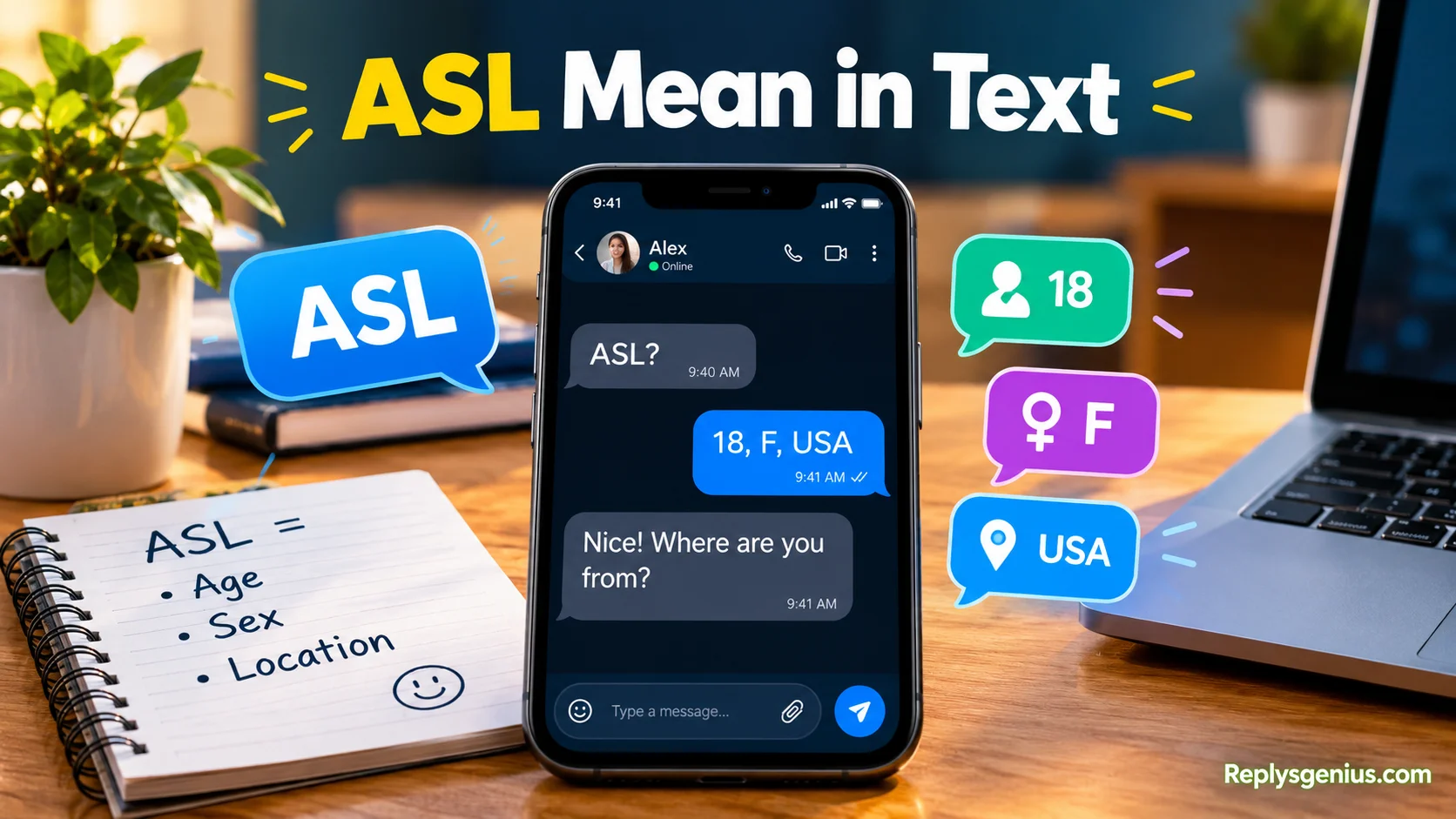
In older online chat culture, ASL stands for Age, Sex, Location.
Each letter represents one piece of information:
| Letter | Meaning | What the person is asking |
| A | Age | How old are you? |
| S | Sex | What is your sex? |
| L | Location | Where are you located? |
A person might simply type:
“ASL?”
The message is essentially asking, “How old are you, what is your sex, and where are you located?”
The abbreviation became especially recognizable in early online chat environments where users often wanted a quick introduction. Instead of typing three separate questions, someone could use three letters.
You may also see the same idea written as “A/S/L?” The slashes don’t change the basic meaning. They simply reflect another common way people wrote the abbreviation.
Today, this use still appears occasionally. However, it is much more closely associated with older internet chat culture than with everyday modern texting.
ASL Meaning in Text at a Glance
The easiest way to understand ASL meaning in text is to look at the context around it.
| ASL meaning | Typical context | Example |
| Age, Sex, Location | Online chat or an introductory DM | “Hey, ASL?” |
| American Sign Language | Deaf culture, education, accessibility, language | “Do you know ASL?” |
| A/S/L | Older chat-room style | “A/S/L?” |
There’s an important difference between these meanings.
When someone asks “ASL?” as a standalone message, the older internet meaning may be intended. When someone discusses signing, interpreting, Deaf communities, or language classes, American Sign Language is the more likely meaning.
Context acts like a decoder ring. You don’t need to memorize every possible definition if you pay attention to the conversation.
What Does “ASL?” Mean When Someone Texts You?
When someone sends “ASL?” without any additional context, the traditional chat interpretation is “Age, Sex, Location?”
For example:
Alex: Hey, what’s up?
Jordan: Not much. You?
Alex: Good. ASL?
Jordan: 23, male, Chicago.
Here, the meaning is straightforward. Alex wants three basic details about Jordan.
The abbreviation can feel unusual to people who mainly use modern messaging apps. That’s because today’s conversations usually ask these questions separately, if they’re asked at all.
A person might now say:
- “How old are you?”
- “Where are you from?”
- “What city are you in?”
- “Where do you live?”
- “What are your pronouns?”
Notice that these questions aren’t necessarily interchangeable with the original ASL formula. Modern conversations often use more specific language because people have different preferences around identity and privacy.
If you’re unsure what someone means by ASL, asking is perfectly reasonable:
“Do you mean age, sex, location?”
Or:
“Do you mean American Sign Language?”
One short clarification can prevent an awkward misunderstanding.
What Does ASL Mean in Chat and Online Conversations?
The Age, Sex, Location meaning belongs strongly to the history of online chat.
Early internet conversations often moved quickly. Users communicated through chat rooms and instant messaging services where short abbreviations saved typing time. Terms such as LOL, BRB, and A/S/L became recognizable parts of online communication.
The question “A/S/L?” became a familiar way for strangers to exchange basic personal information.
Imagine entering a public chat room where you know nobody. Instead of writing a long introduction, another person might send:
A/S/L?
The message immediately invites a basic introduction.
This style feels dated now because internet communication has changed dramatically. Social media profiles, usernames, photos, bios, location tags, and other profile information can already provide context that older chat rooms didn’t have.
Still, the abbreviation hasn’t become meaningless. You may encounter it in older conversations, online communities, nostalgic references to internet culture, or occasional modern chats.
How ASL Was Used in Early Internet Chat Rooms
The A/S/L format became closely associated with early internet chat culture because it condensed three personal questions into a tiny amount of text.
A typical exchange might look like this:
Person 1: ASL?
Person 2: 21/F/NYC
Person 1: 24/M/Texas
The response could also use abbreviations:
- 21 = age
- F = female
- NYC = New York City
- 24 = age
- M = male
- Texas = location
This format was efficient, but it also had limitations. It encouraged strangers to exchange personal details before establishing much trust.
That’s an important part of understanding the term historically. ASL wasn’t simply slang for casual conversation. It reflected the way strangers introduced themselves in certain early online environments.
Modern platforms work differently. People can communicate through profiles, mutual connections, photos, communities, and longer conversations before sharing personal information.
ASL Meaning on Snapchat, Instagram, TikTok, and Social Media
The meaning of ASL on Snapchat, Instagram, TikTok, or other social platforms depends heavily on the conversation.
If someone sends:
“ASL?”
in a random DM, they may be using the traditional Age, Sex, Location meaning.
But if a TikTok creator posts about learning sign language and writes:
“I started learning ASL this year.”
the meaning is American Sign Language.
The same three letters can therefore point to completely different subjects.
Social media also makes context easier to find. A profile, caption, hashtag, video topic, or previous message may reveal the intended meaning.
Example: Social DM
Person A: Hey, where are you from?
Person B: California. ASL?
Here, Age, Sex, Location is a reasonable interpretation because the conversation already concerns personal details.
Example: Language Discussion
Person A: I’m thinking about learning ASL.
Person B: That’s great! Are you taking a class?
Here, American Sign Language is clearly intended.
Example: Ambiguous Message
Person A: Do you know ASL?
This could mean either “Do you know American Sign Language?” or something related to the older chat abbreviation. The surrounding conversation should settle it.
ASL Meaning in Discord and Gaming Chats
Discord conversations move quickly, so abbreviations are common. However, ASL doesn’t have one guaranteed gaming-specific definition.
If someone joins a community and sends:
“ASL?”
they could be using the older Age, Sex, Location question.
Suppose the conversation is instead about accessibility:
User 1: Does anyone here know ASL?
User 2: Yes. I can sign.
In that case, American Sign Language makes much more sense.
Gaming communities also contain many specialized abbreviations. That’s why guessing from the letters alone can backfire.
A useful rule is simple:
Read the sentence before decoding the acronym.
The topic usually provides the strongest clue.
ASL vs. American Sign Language
One of the most important parts of understanding ASL mean in text is recognizing that American Sign Language is not merely an internet abbreviation.
American Sign Language is a natural visual language with its own grammar and linguistic structure. The National Institute on Deafness and Other Communication Disorders explains that ASL is a complete, natural language used by many Deaf and hard-of-hearing people in the United States and parts of Canada.
The language doesn’t simply translate spoken English word for word. It uses visual communication involving the hands, facial expressions, body movement, and spatial relationships.
The National Association of the Deaf also describes ASL as a visual language with its own linguistic structure.
Useful sources include:
So when someone says “I speak ASL,” they aren’t necessarily talking about internet slang. They may be referring to their ability to communicate in American Sign Language.
How to Tell Which ASL Meaning Someone Intended
When you encounter ASL, use the surrounding conversation as your guide.
Look at the topic
If the conversation involves:
- Deaf communities
- Signing
- Interpreters
- Accessibility
- Language classes
- Communication
- Hearing loss
then American Sign Language is probably the intended meaning.
If the conversation involves:
- Meeting strangers
- Online introductions
- Dating
- Age
- Gender or sex
- Location
then Age, Sex, Location may be intended.
Look at the sentence
Compare these two messages:
“ASL?”
and:
“Where can I learn ASL?”
The first could be ambiguous. The second strongly points toward American Sign Language.
Look at the conversation history
Acronyms rarely exist in isolation. The previous few messages often provide the missing puzzle piece.
When the context still doesn’t make sense, simply ask:
“Which ASL do you mean?”
That’s clearer than guessing.
Examples of ASL in Text Messages
Realistic examples make the difference easier to understand.
Example: Traditional Chat Meaning
Sam: Hey! Nice to meet you.
Chris: You too. ASL?
Sam: 22, female, Florida.
Here, ASL means “Age, Sex, Location.”
Chris is asking for basic personal information.
Example: American Sign Language
Sam: Are you learning ASL?
Chris: Yes. I’ve been taking classes for six months.
Here, ASL means “American Sign Language.”
The word learning makes the intended meaning clear.
Example: Asking for Clarification
Sam: Do you know ASL?
Chris: Do you mean American Sign Language?
This response works because the original question doesn’t provide enough context.
Example: Older Internet Style
User 1: A/S/L?
User 2: 25/M/Denver.
The slash format represents the same basic Age, Sex, Location question.
How to Reply to “ASL?” in Text
You don’t have to answer an ASL question simply because someone asks.
If you know what the person means and feel comfortable sharing the information, you can respond naturally.
For example:
“I’m 24 and live near Dallas.”
You don’t necessarily need to provide every detail in the traditional format.
If you’re uncomfortable, you can keep your answer broad:
“I’m in Texas, but I don’t share my exact location online.”
You can also decline completely:
“I don’t share personal details with people I don’t know.”
Or clarify the abbreviation:
“Do you mean age, sex, and location?”
This is especially useful when someone sends only “ASL?” without any context.
Is It Safe to Answer ASL From a Stranger?
An ASL question can look harmless because each individual detail may seem basic. However, combining personal details can reveal more information than expected.
For example, these three pieces:
- Age: 16
- Sex: Female
- Location: A specific small town
could provide a stranger with a surprisingly narrow description of the person.
That’s why privacy matters when talking to unknown people online.
Practical safety tips
- Don’t share your exact home address.
- Avoid giving precise real-time locations.
- Don’t reveal your school or workplace to strangers.
- Use a broad region instead of an exact location when appropriate.
- Be especially cautious when a stranger presses for more details.
- Don’t assume someone is trustworthy because they seem friendly.
For minors, online privacy deserves particular care. A simple question can sometimes lead to increasingly personal questions.
The safest response isn’t always a complete refusal. Sometimes a vague answer is enough:
“I’m in the Midwest.”
That gives broad context without handing over a precise location.
Is ASL Still Common in Texting?
The Age, Sex, Location meaning still exists, but it isn’t as central to everyday internet communication as it was in older chat culture.
Modern users often have profiles that already reveal basic information. They may also prefer more direct questions.
Instead of:
“ASL?”
someone might write:
“Where are you from?”
or:
“How old are you?”
The shift reflects a broader change in online communication. People don’t need to compress every question into a few letters anymore.
Still, older abbreviations can survive for decades. Internet slang behaves a bit like an old song on a streaming playlist: something can become less common without disappearing completely.
Read More: IMO Meaning in Text: What Does IMO Mean in Texting?
Why Does ASL Have Multiple Meanings?
Acronyms naturally develop multiple meanings because different communities reuse the same letters.
ASL is a good example.
In one environment, users may interpret it as Age, Sex, Location. In another, educators, interpreters, students, or Deaf community members may understand it as American Sign Language.
Neither meaning cancels out the other.
The key is context.
This happens frequently online because text removes many clues found in face-to-face conversation. You can’t hear someone’s tone or immediately see their surroundings. A short acronym can therefore become surprisingly ambiguous.
That’s why a three-letter message can require more interpretation than a full sentence.
ASL Meaning in Different Contexts
Here’s a quick comparison:
| Context | Likely ASL meaning |
| “ASL?” from a stranger | Age, Sex, Location |
| Early-style online chat | Age, Sex, Location |
| “A/S/L?” | Age, Sex, Location |
| Deaf community discussion | American Sign Language |
| Sign-language class | American Sign Language |
| Accessibility discussion | American Sign Language |
| “Do you speak ASL?” | American Sign Language |
| “What’s your ASL?” with no context | Ask for clarification |
These examples aren’t absolute rules. They are practical clues.
For instance, someone could discuss American Sign Language in a casual DM. Likewise, someone could use ASL as an old-fashioned chat abbreviation on a modern platform.
The surrounding words matter more than the platform name.
ASL vs. A/S/L: Are They the Same?
When ASL refers to Age, Sex, Location, the version A/S/L generally expresses the same idea.
The difference is mainly formatting.
Compare:
ASL?
with:
A/S/L?
Both can mean:
Age? Sex? Location?
The slash version is strongly associated with older online chat conventions.
You may encounter A/S/L when reading old forum posts, archived conversations, discussions about internet history, or references to early chat culture.
Today, someone may also use ASL without slashes simply because modern text favors shorter forms.
ASL vs. Other Texting Abbreviations
Understanding ASL becomes easier when you compare it with other familiar internet shorthand.
| Abbreviation | Common meaning | Typical use |
| ASL | Age, Sex, Location | Older online chat |
| A/S/L | Age, Sex, Location | Older chat-room style |
| LOL | Laughing out loud | Reactions and humor |
| BRB | Be right back | Temporary absence |
| DM | Direct message | Private social-media communication |
| IDK | I don’t know | Casual texting |
| FYI | For your information | Information sharing |
Unlike LOL or IDK, the Age, Sex, Location meaning of ASL can request personal information. That makes the context especially important.
Common Mistakes When Understanding ASL
A few assumptions can easily lead to confusion.
Assuming ASL Always Means American Sign Language
The abbreviation has a well-established internet-chat meaning too. A standalone “ASL?” may refer to age, sex, and location.
Assuming ASL Always Means Age, Sex, Location
That’s equally inaccurate. In education, accessibility, and Deaf-community contexts, ASL commonly means American Sign Language.
Sharing Too Much Information
Someone asking “ASL?” doesn’t automatically deserve your personal details. You decide what information you want to share.
Confusing Sex With Other Identity Terms
The traditional abbreviation uses sex, but modern conversations may distinguish sex, gender identity, and pronouns. Don’t assume that an old abbreviation captures all of those concepts.
Ignoring Context
Trying to decode an acronym from three letters alone is often a recipe for misunderstanding.
Treating Historical Slang as Universal Modern Slang
Some abbreviations remain recognizable long after their peak. That doesn’t mean everyone uses them regularly today.
When Should You Use ASL in a Text?
If you’re using ASL to mean American Sign Language, the abbreviation is perfectly appropriate when your audience understands the context.
For example:
“I’m taking an ASL course this semester.”
That’s clear.
Using ASL to mean Age, Sex, Location requires more thought. The abbreviation can feel dated and can also come across as overly direct when used with strangers.
Instead of automatically asking:
“ASL?”
a modern conversation may work better with a specific question:
“Where are you from?”
or:
“How old are you?”
This approach gives the other person more control over what they share.
When Shouldn’t You Use ASL in a Text?
Avoid using the Age, Sex, Location abbreviation when the recipient may not recognize it.
It can also create confusion in professional conversations. If you’re discussing American Sign Language, spelling out the term the first time can help:
“American Sign Language (ASL)”
After that, ASL becomes clear.
You should also avoid asking strangers for sensitive information without a good reason. An abbreviation doesn’t make a personal question automatically appropriate.
In formal writing, direct language usually beats slang.
ASL Meaning in School, Work, and Professional Communication
In schools and workplaces, ASL most often appears in discussions about American Sign Language.
You might see it in:
- Language courses
- Interpreter training
- Accessibility programs
- Deaf studies
- Educational services
- Workplace accessibility
- Community programs
- Communication resources
For example:
“The college offers introductory ASL courses.”
Here, the meaning is clearly American Sign Language.
The older Age, Sex, Location interpretation generally doesn’t belong in professional communication. If personal demographic information is genuinely needed for a legitimate purpose, organizations usually use clear and specific language rather than an old chat abbreviation.
The History Behind ASL as Internet Slang
The Age, Sex, Location use of ASL grew alongside early online chat culture.
When internet users entered public chat rooms, they often had little information about one another. Profiles were less detailed than many modern social-media accounts. A short introduction could therefore start with a question about age, sex, and location.
The compact form A/S/L? became recognizable shorthand.
This fits the broader pattern of early internet language. Users developed abbreviations because typing was slower, interfaces were more limited, and conversations often moved rapidly.
Terms such as BRB, LOL, and A/S/L became part of that evolving vocabulary.
The important point is that ASL’s chat meaning has a historical context. It shouldn’t automatically be treated as one of the dominant forms of modern texting slang.
Why ASL Can Sound Different to Different Generations
Internet language changes quickly.
Someone who spent time in early chat rooms may immediately recognize A/S/L as a request for age, sex, and location. Someone who learned about ASL through school or accessibility discussions may immediately think of American Sign Language.
Neither reaction is surprising.
Language doesn’t live in a dictionary alone. Communities give words and abbreviations their meaning.
Consider these two messages:
“ASL?”
and:
“I’m learning ASL.”
The first has a strong connection to old chat slang. The second strongly suggests American Sign Language.
That difference explains why context matters so much when interpreting short internet expressions.
A Simple Case Study: When ASL Creates Confusion
Consider this fictional conversation:
Taylor: Hey, nice to meet you! ASL?
Morgan: I’m learning ASL right now.
Taylor: Oh, cool! How long have you been studying it?
Morgan: About a year.
The conversation goes off track because Morgan interpreted ASL as American Sign Language while Taylor intended Age, Sex, Location.
Neither person necessarily made a grammatical mistake. They simply attached different meanings to the same abbreviation.
A better response from Morgan could have been:
“Do you mean American Sign Language?”
That single question would have cleared everything up.
This is a useful lesson for any ambiguous abbreviation: when two meanings make sense, clarification beats guessing.
How to Reply to “ASL?” Without Sharing Personal Details
You can respond in several ways depending on your comfort level.
If You Want Clarification
“What do you mean by ASL?”
This is the safest option when the meaning isn’t obvious.
If You Want to Give a Broad Answer
“I’m in California, but I don’t share my exact location.”
This provides useful information without revealing an address.
If You Don’t Want to Answer
“I don’t share personal information with people online.”
It’s direct without being rude.
If You Think They Mean American Sign Language
“Do you mean American Sign Language?”
This works especially well when the conversation involves language or accessibility.
ASL Meaning: Quick Reference Table
| Question | Answer |
| What does ASL mean in old-style chat? | Age, Sex, Location |
| What does ASL mean in accessibility discussions? | American Sign Language |
| What does A/S/L mean? | Age, Sex, Location |
| Is ASL still used for Age, Sex, Location? | Yes, although that usage is associated more strongly with older internet chat culture |
| Is ASL always slang? | No. It is also a standard abbreviation for American Sign Language |
| Does “ASL?” always mean American Sign Language? | No |
| Should you share your exact location with a stranger? | Not simply because they ask |
| What should you do if the meaning isn’t clear? | Ask the sender what they mean |
FAQs
1. What does ASL mean in text?
ASL most commonly means age, sex, location in older internet slang. It was often used as a quick shorthand question when someone wanted basic information about another person.
2. What does ASL mean on social media?
On social media, ASL can have different meanings depending on the context. It may refer to age, sex, location, American Sign Language, or as hell in modern slang.
3. What does “asl” mean in texting slang?
In texting slang, lowercase asl can mean as hell, especially in phrases such as “tired asl.” However, older online conversations may use it for age, sex, location.
4. Is ASL still used by teens?
Some teens may use ASL in online chats and modern texting, but its meaning depends heavily on the platform, conversation, and surrounding words.
5. How should I respond when someone says ASL?
First, check the context. If someone is asking age, sex, location, you can answer only if you’re comfortable sharing those details. You can also ask what they mean if the message seems confusing.
Conclusion
Understanding ASL Mean in Text becomes easier when you pay attention to context, platform, and the rest of the conversation. The traditional ASL slang meaning is age, sex, location, while newer uses can include as hell. It can also refer to American Sign Language, so the surrounding message usually tells you which definition fits.
Whether you encounter ASL in text messages, social media, or online chats, don’t assume there is only one meaning. Look at how the abbreviation is being used, consider who sent it, and respond only when you feel comfortable. Knowing these differences can make modern texting and internet slang much easier to understand.