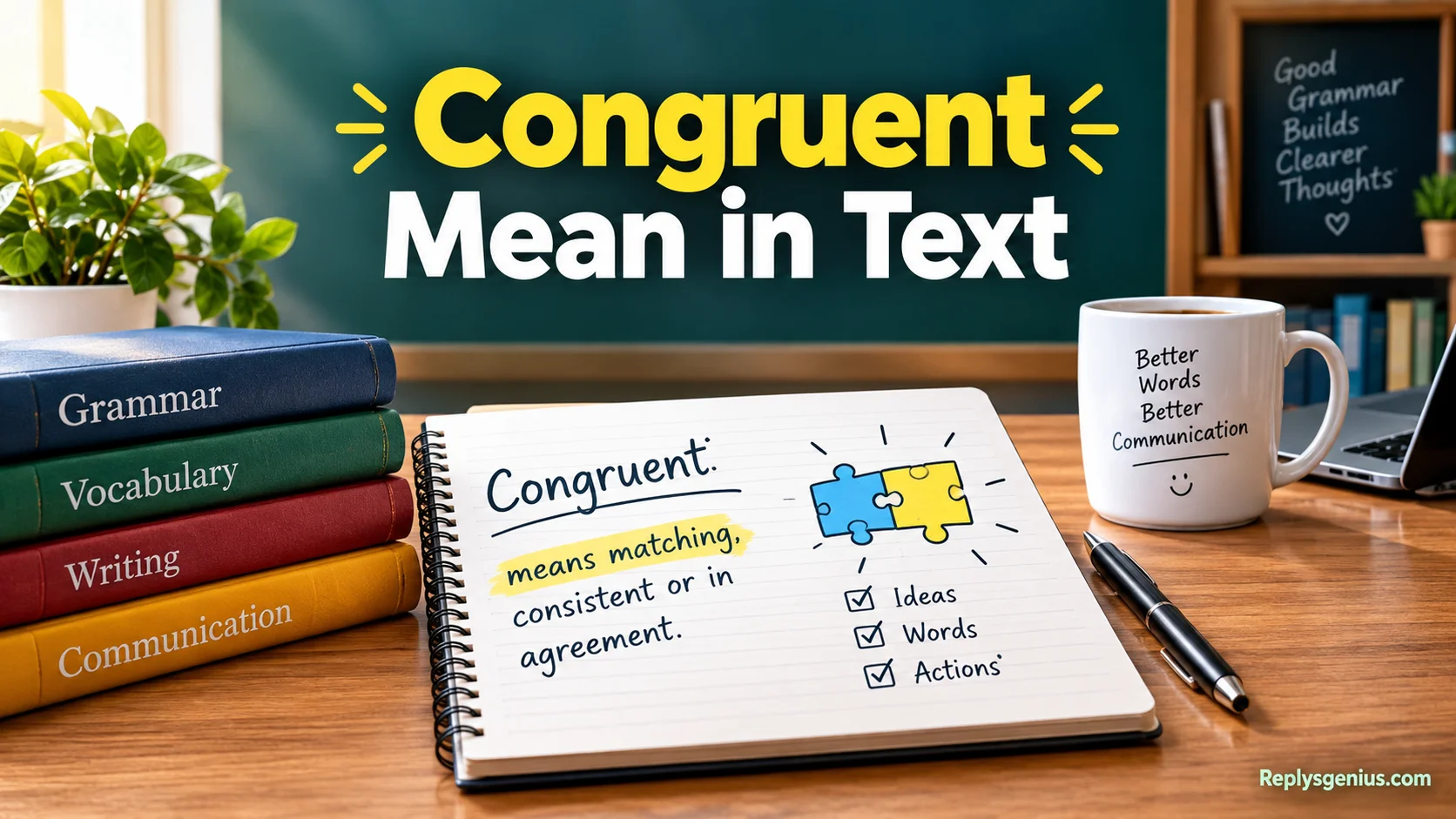
For students, professionals, and everyday internet users, Congruent Mean in Text offers a clear, simple explanation of how congruent can match, align, or agree in real life. In my experience, this word is often associated with psychology, communication, social media, and casual conversation, where congruent meaning helps people understand what a message refers to. When people search for an answer, the term can apply to emotions, behavior, shapes, opinions, and messages, making it relevant in 2026.
In a social and behavioral context, congruent describes a state of precise alignment and correspondence, especially when a seamless match exists between internal beliefs and external actions. This gives the term a connotation of authenticity and integrity. I would describe consistent and matching as familiar alternatives, while congruent sounds more formal and suggests structural or logical harmony. In online communication, consistency can matter because words, emotions, and actions appear more authentic when they naturally align.
In mathematics, specifically geometry, congruent has an absolute identity in shape and size. Two figures are congruent when one can be superimposed exactly onto the other, regardless of their orientation or position in space. This technical application focuses on exactitude rather than mere similarity. If you remember grade school, this may be the meaning that first crossed your path. The mathematical sense is also useful beyond geometry because it describes a strong relationship where elements correspond precisely. You can use the term in a sentence when comparing ideas, forms, or situations.
What Does Congruent Mean in Text?
In ordinary texting and online conversations, congruent means matching, agreeing, or being consistent with something else.
For example, imagine someone tells a friend:
“I care about the environment, so I avoid wasting food.”
A response might say:
“Your actions are congruent with your values.”
Here, congruent means that the person’s actions match their stated values.
The word doesn’t suddenly become a new slang term just because someone uses it in a text message. Instead, it keeps its standard English meaning.
You might encounter it in conversations about:
- Opinions and behavior
- Words and actions
- Personal values
- Feelings and expressions
- Goals and decisions
- School assignments
- Mathematics
- Psychology
- Professional communication
The simplest way to remember the everyday meaning is:
Congruent = matching or agreeing in a meaningful way.
For example:
“Her response was congruent with what she said earlier.”
This means her response matched or agreed with her earlier statement.
Congruent Meaning in Simple English
The word congruent can sound more complicated than it really is. In simple English, it usually means that two things fit together, correspond, or match.
Consider these examples:
| Sentence | Simple meaning |
| “His actions are congruent with his beliefs.” | His actions match his beliefs. |
| “The results are congruent with the theory.” | The results agree with the theory. |
| “Her behavior wasn’t congruent with her words.” | Her behavior didn’t match what she said. |
| “These two figures are congruent.” | The figures have the same shape and size. |
The exact meaning changes slightly depending on the subject.
In everyday language, congruent often focuses on agreement or consistency. In geometry, it has a much more precise definition.
That distinction matters because using the word in a math class isn’t the same as using it in a casual conversation.
Is Congruent a Texting Slang or Abbreviation?
No. Congruent is not normally a texting abbreviation or internet slang term.
Unlike abbreviations such as LOL, BRB, IDK, or IMO, the word “congruent” is normally written as a complete word.
Someone might use it in a text because they’re discussing school, psychology, work, relationships, or another subject where the word fits naturally.
For example:
“Your explanation is congruent with what we learned in class.”
That doesn’t create a special texting definition. It simply uses the normal English meaning in a digital conversation.
This is an important distinction for anyone searching “what does congruent mean in text?” The phrase “in text” can refer to a word appearing inside a message. It doesn’t necessarily mean the word has a special slang definition.
Congruent in Everyday Text Messages
Although congruent isn’t casual slang, people can still use it in text messages.
It tends to appear more often when someone wants to describe a clear connection between two things. The word can sound more formal than matching, consistent, or in line with.
For example:
“Your actions aren’t congruent with what you promised.”
The speaker means that the person’s actions don’t match their promise.
Another example could involve personal goals:
“Your new routine seems congruent with your fitness goals.”
In simpler language, this means:
“Your new routine seems to match your fitness goals.”
Here are several realistic texting examples:
| Text | Meaning |
| “That decision isn’t congruent with your goals.” | The decision doesn’t match the goals. |
| “Her reaction was congruent with the situation.” | Her reaction made sense for the situation. |
| “Your answer is congruent with mine.” | Your answer agrees with mine. |
| “His actions aren’t congruent with his promises.” | His actions don’t match his promises. |
In a casual chat, however, match, fit, or make sense may sound more natural.
Congruent Meaning in Geometry
Geometry gives congruent a precise mathematical meaning.
Two geometric figures are congruent when they have exactly the same shape and size. Their position doesn’t have to be the same.
One figure can move, rotate, or reflect and still remain congruent to another figure.
Imagine cutting a triangle from a piece of paper. Now rotate that triangle and place it beside another triangle with exactly the same measurements. The triangles may point in different directions, but they can still be congruent.
The symbol used for congruence is:
≅
For example:
△ABC ≅ △DEF
This statement says that triangle ABC is congruent to triangle DEF.
In geometry, congruence isn’t based on appearance alone. Measurements and corresponding parts establish whether figures are truly congruent.
Congruent vs Similar in Geometry
One of the most common sources of confusion is the difference between congruent and similar.
Both concepts involve shapes that have the same general form. The key difference is size.
Congruent figures have the same shape and the same size.
Similar figures have the same shape but don’t necessarily have the same size.
For example, two squares measuring 5 inches on each side are congruent if their corresponding measurements match.
A 5-inch square and a 10-inch square have the same shape. However, they aren’t congruent because their sizes differ. They can be similar instead.
| Feature | Congruent | Similar |
| Same shape | Yes | Yes |
| Same size | Yes | Not necessarily |
| Corresponding angles | Equal | Equal |
| Corresponding sides | Equal | Proportional |
| Can be rotated? | Yes | Yes |
| Can be reflected? | Yes | Yes |
A useful memory trick is simple:
Congruent means same shape and same size. Similar means same shape, possibly different size.
How to Tell If Two Figures Are Congruent
You can’t always determine congruence just by looking at two figures. Geometry uses specific rules to establish whether figures, especially triangles, are congruent.
For triangles, the main congruence criteria include:
- SSS — Side-Side-Side
- SAS — Side-Angle-Side
- ASA — Angle-Side-Angle
- AAS — Angle-Angle-Side
- HL — Hypotenuse-Leg for right triangles
SSS
SSS means that all three corresponding sides of two triangles have equal lengths.
If one triangle has side lengths of 4 cm, 5 cm, and 6 cm and another triangle has corresponding sides of 4 cm, 5 cm, and 6 cm, the triangles are congruent.
SAS
SAS uses two corresponding sides and the included angle between them.
For example, if two triangles have matching side lengths of 5 cm and 7 cm and the angle between those sides is the same, SAS can establish congruence.
ASA
ASA compares two corresponding angles and the side between them.
AAS
AAS compares two corresponding angles and a side that isn’t between those two angles.
HL
HL applies specifically to right triangles. It compares the hypotenuse and one corresponding leg.
These criteria provide mathematical evidence rather than relying on visual appearance.
Congruent Triangles Explained
Congruent triangles have the same size and shape.
Their corresponding sides have equal lengths, while their corresponding angles have equal measures.
Suppose:
- Triangle ABC has sides 3 cm, 4 cm, and 5 cm.
- Triangle DEF also has sides 3 cm, 4 cm, and 5 cm.
The triangles satisfy SSS congruence.
However, the order in which triangle names appear matters when writing a formal congruence statement.
For example:
△ABC ≅ △DEF
This pairing indicates the corresponding vertices:
- A ↔ D
- B ↔ E
- C ↔ F
That correspondence helps you identify matching sides and angles.
Congruence therefore involves more than saying, “These triangles look the same.” It establishes a precise relationship between their parts.
Congruent Shapes and Figures
Congruence isn’t limited to triangles.
Many geometric figures can be congruent, including:
- Squares
- Rectangles
- Circles
- Pentagons
- Hexagons
- Other polygons
- Line segments
- Angles
Suppose two rectangles both measure 8 cm by 3 cm. They can be congruent even if one is turned vertically and the other lies horizontally.
Rotation doesn’t change the measurements.
Reflection doesn’t automatically change congruence either. If you flip a figure like a paper cutout and its corresponding measurements still match, the figures can remain congruent.
This is why position alone doesn’t determine congruence.
Congruent Angles and Line Segments
The word congruent also applies to individual geometric parts.
Two angles are congruent when they have the same measure.
For example:
- 30° and 30° are congruent angles.
- 90° and 90° are congruent angles.
- 45° and 50° aren’t congruent.
The same idea applies to line segments.
A 7-cm segment and another 7-cm segment are congruent because they have the same length.
In mathematical notation, congruent angles or segments can be identified with the ≅ symbol.
For example:
∠A ≅ ∠B
This means the two angles have equal measures.
Likewise:
AB ≅ CD
means the two line segments have equal lengths.
Congruent vs Equal
The words congruent and equal are related, but they aren’t always interchangeable.
In ordinary English, someone may use “equal” to describe two things that have the same value.
In geometry, congruent is more specific when comparing figures or geometric objects.
For example, saying two line segments are congruent means they have the same length.
However, saying two triangles are congruent communicates more information. It tells you that the triangles have the same shape and size, with corresponding parts matching.
A simple way to separate them is:
- Equal often compares values or measurements.
- Congruent compares geometric objects or corresponding parts.
That distinction becomes particularly useful in formal mathematical writing.
Congruent vs Equivalent
Equivalent usually means that two things have the same value, meaning, function, or effect.
For example:
1/2 = 2/4
These fractions are equivalent because they represent the same numerical value.
Congruence has a different focus.
Two geometric figures can be congruent because they have matching dimensions and shape. The word describes a relationship between geometric objects rather than simply saying that two expressions have the same value.
In everyday language, however, the terms can sometimes overlap loosely when someone talks about things that correspond or agree.
The context tells you which meaning matters.
Congruent vs Consistent
Consistent means that something agrees with something else or doesn’t contradict it.
Congruent can also communicate agreement, but it often emphasizes a stronger sense of correspondence or alignment.
Compare these examples:
“His story is consistent with the evidence.”
This means the story doesn’t conflict with the evidence.
Now consider:
“His actions are congruent with his stated values.”
This emphasizes that his behavior matches or aligns with his values.
The two words can overlap, yet they aren’t always interchangeable.
When you want to emphasize alignment between two things, congruent can be a precise choice.
Congruent vs Compatible
Compatible generally means that two things can exist, work, or function together without causing a conflict.
For example:
“This charger is compatible with my phone.”
The charger doesn’t have to be identical to the phone. It simply needs to work with it.
By contrast:
“His actions are congruent with his beliefs.”
Here, the focus is on a match or alignment between actions and beliefs.
So, compatible focuses more on working together, while congruent often focuses on correspondence or agreement.
Congruent in Psychology and Counseling
The word congruence has an established meaning in psychology, particularly within Carl Rogers’ person-centered approach.
In this context, congruence relates to alignment between a person’s internal experience and outward expression.
For example, imagine someone feels genuinely upset but tells everyone that everything is wonderful while behaving as though nothing bothers them. Their outward expression doesn’t accurately reflect their internal experience.
Congruence describes a greater sense of alignment between what someone experiences and what they communicate.
This psychological use is different from the mathematical definition. The underlying idea of correspondence remains, but the subject changes.
The broader concept can be summarized as:
Inner experience ↔ outward expression
This is one reason the word sometimes appears in discussions about authenticity, communication, counseling, and emotional expression.
For more background, see the American Psychological Association and resources covering person-centered therapy and Rogers’ work.
Congruent in Professional and Academic Writing
You may encounter congruent more frequently in formal writing than casual conversation.
Researchers, teachers, psychologists, mathematicians, and professionals may use it when they need to describe a precise relationship between ideas or observations.
Examples include:
“The findings are congruent with previous research.”
This means the findings agree with earlier research.
Another example:
“The proposed strategy is congruent with the organization’s stated goals.”
Here, the strategy aligns with those goals.
The word can make writing more precise, but it shouldn’t replace simpler language when simplicity works better.
For example:
Formal:
“The employee’s behavior was congruent with the company’s expectations.”
Simpler:
“The employee’s behavior matched the company’s expectations.”
Both communicate the central idea. The second version may feel more natural in everyday communication.
Congruent in a Sentence
Seeing the word in different contexts makes its meaning much easier to understand.
Everyday communication:
“Her decision was congruent with her personal values.”
Meaning: Her decision matched her values.
Text messaging:
“That doesn’t seem congruent with what you told me yesterday.”
Meaning: That doesn’t seem consistent with what you previously said.
Workplace communication:
“The proposal is congruent with our long-term objectives.”
Meaning: The proposal aligns with the organization’s objectives.
Psychology:
“Congruent communication reflects a closer match between internal experience and outward expression.”
Meaning: What a person communicates more closely reflects what they actually experience.
Geometry:
“These two triangles are congruent.”
Meaning: They have the same shape and size.
Academic writing:
“The results are congruent with the original hypothesis.”
Meaning: The results agree with or support the expected idea.
These examples show why context matters more than the word “text.”
How to Use Congruent Correctly
Congruent works as an adjective.
One common structure is:
Something is congruent with something else.
For example:
“Her actions are congruent with her beliefs.”
Another structure appears in mathematical contexts:
“Triangle ABC is congruent to triangle DEF.”
Both forms communicate correspondence, but the surrounding context determines the most natural construction.
Here are some useful patterns:
| Pattern | Example |
| Congruent with | “His actions are congruent with his beliefs.” |
| Congruent to | “Triangle ABC is congruent to triangle DEF.” |
| Congruent figures | “The diagram shows two congruent figures.” |
| Congruent angles | “The two angles are congruent.” |
| Congruent triangles | “The triangles are congruent by SSS.” |
When writing for a general audience, don’t force the word into every sentence. Match, consistent, aligned, and in line with are often easier to understand.
Common Mistakes With the Word Congruent
Several misunderstandings can make the word seem more complicated than it is.
Treating congruent as texting slang
Congruent isn’t normally an abbreviation or slang expression. It usually carries its standard dictionary meaning.
Assuming congruent always means identical
In everyday language, congruent can mean matching or corresponding. In geometry, it specifically describes figures with the same shape and size.
Confusing congruent with similar
This is one of the biggest math mistakes.
Similar figures can have different sizes. Congruent figures cannot.
Ignoring context
A message about triangles requires a mathematical interpretation. A message about someone’s behavior may require the everyday meaning.
Using congruent when a simpler word works
If you’re texting a friend, saying “That matches what you said” may sound much more natural than “That is congruent with your statement.”
Thinking position changes congruence
A geometric figure can be rotated, moved, or reflected and still remain congruent to another figure.
Congruent Meaning on Social Media and Online Chats
The word congruent can appear on social media without having a unique social-media definition.
You might encounter it in educational posts, psychology discussions, relationship advice, academic communities, or debates.
For example:
“Your online persona should be congruent with your real values.”
Here, congruent means aligned or consistent.
Another post might say:
“These two shapes are congruent.”
In that case, the person is almost certainly discussing geometry.
Social media often mixes casual language with academic and professional vocabulary. That’s why a standard word can appear unusual in a chat even when it has no special slang meaning.
The surrounding sentence provides the strongest clue.
How to Reply When Someone Uses “Congruent” in a Text
If someone uses congruent in a message, first look at what they’re discussing.
If they’re talking about behavior:
“I agree. Your actions definitely match what you said.”
If they’re discussing school:
“Do you mean the two figures have the same shape and size?”
If they’re discussing goals:
“Yes, that decision seems aligned with your goals.”
If you’re unsure:
“When you say congruent, do you mean they match?”
That’s a perfectly natural clarification.
You don’t need to assume that the person is using secret slang. In most situations, the surrounding words reveal the intended meaning.
A Real-World Example of Congruent Meaning
Consider a workplace conversation.
A manager says:
“Our company says customer service is a priority.”
However, employees notice that customer complaints rarely receive responses.
One employee might say:
“The company’s actions aren’t congruent with its stated commitment to customer service.”
The employee isn’t saying the company’s actions are literally identical to its words. The point is that the actions don’t align with the stated values.
Now change the situation to geometry.
A teacher shows students two triangles. Both have side lengths of:
- 5 cm
- 7 cm
- 8 cm
The teacher explains that the triangles are congruent because their corresponding sides have equal lengths.
The same word appears in both examples, but its precise meaning depends on the field.
That’s the central lesson: congruent always involves some form of correspondence, but the thing being compared changes with the context.
Quick Comparison of Congruent Meanings
| Context | What “Congruent” Means | Example |
| Everyday English | Matching or agreeing | “Her actions are congruent with her words.” |
| Text messages | Usually the standard English meaning | “That isn’t congruent with what you said.” |
| Geometry | Same shape and size | “The triangles are congruent.” |
| Angles | Same measurement | “Both angles are 60° and congruent.” |
| Line segments | Same length | “The two segments are congruent.” |
| Psychology | Alignment between internal experience and outward expression | “His communication appears congruent.” |
| Academic writing | Corresponding or agreeing | “The findings are congruent with previous research.” |
| Business | Aligned with a goal or policy | “The plan is congruent with our objectives.” |
This table captures the main uses without treating congruent as a separate slang term.
FAQs
1. What does Congruent Mean in Text mean?
Congruent Mean in Text generally refers to something that matches, aligns, or agrees with something else. In everyday communication, it can describe matching ideas, emotions, opinions, or actions.
2. What does congruent mean in simple English?
In simple English, congruent means matching, consistent, or in agreement. For example, when someone’s words and actions match their beliefs, they can be described as congruent.
3. What does congruent mean in mathematics?
In mathematics, especially geometry, congruent means having the same shape and size. Two figures are congruent when one can be superimposed exactly onto the other, even if their position or orientation changes.
4. Can congruent be used in everyday conversation?
Yes. Congruent can be used in casual conversation, although it sounds more formal than words such as matching or consistent. It can describe situations where beliefs, words, and actions agree.
5. What is the difference between congruent and similar?
Congruent usually indicates an exact match, especially in geometry, while similarity means that things share certain features without being exactly the same. The distinction is particularly important in mathematics.
Conclusion
The meaning of congruent depends on the context, but its central idea is alignment, agreement, and correspondence. In social communication, it can describe consistency between internal beliefs and external actions, while in geometry, it refers to figures with exactly the same shape and size. Understanding these uses makes Congruent Mean in Text easier to recognize in both everyday and technical situations.
Whether you encounter congruent in social media, professional communication, psychology, or mathematics, look at how the surrounding words are being used. The term often points to a precise match, logical harmony, or exact correspondence, making it useful when ordinary words such as similar or matching do not fully express the intended meaning.