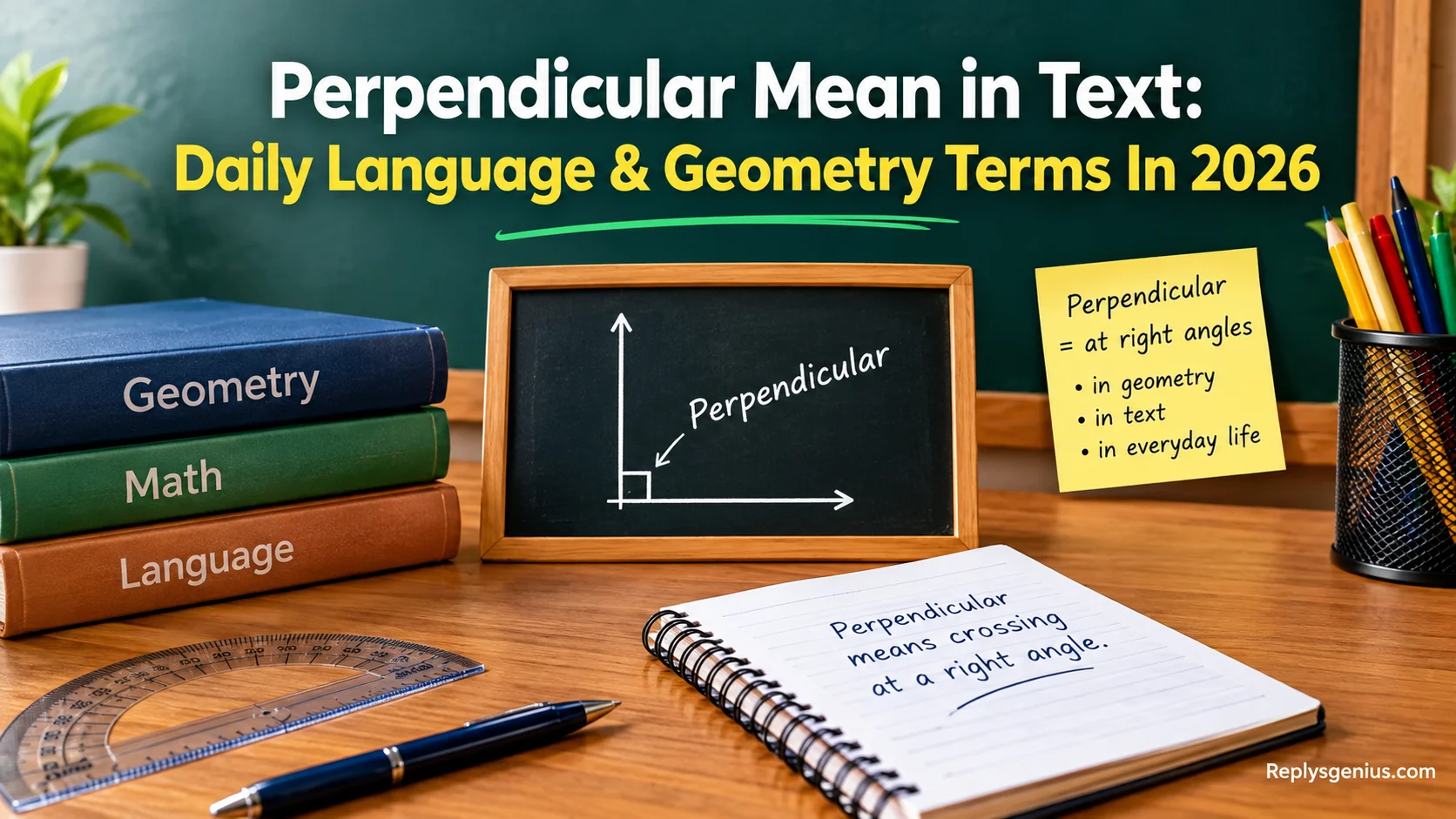
Perpendicular Mean in Text: Daily Language & Geometry Terms In 2026 explains how this useful word connects geometry, language, and everyday talk. In mathematics and geometry, perpendicular describes how lines, line segments, planes, or surfaces meet at a right angle of 90 degrees. A perpendicular line creates an exact L shape, similar to a wall and floor meeting in a room to make a perfect corner. Builders, teachers, and students use this idea in math, science, and design, while the word also appears in daily talk and everyday English when describing something upright, vertical, or related to a particular direction. A perpendicular angle is 90 degrees, and a T makes it easy to see how two lines meet each other. A person standing upright in relation to the earth can also make this basic idea easier to understand.
For English learners and content writers, learning the meaning of perpendicular, its synonyms, and related word forms can reduce repetition and make writing more clear and strong. A practical guide using simple ideas, definitions, examples, and easy-to-follow visuals can explain the concept more naturally than a complex geometry textbook filled with angles, rulers, and angle measurements. Pronunciation, grammar, history, tone, and understanding whether it works as an adjective or noun can also improve everyday use. For comparisons, a compass shows that East and North are perpendicular directions. In a more general sense, the word can describe a steep angle; for example, a ski slope may be nearly perpendicular, although a true 90-degree angle would make you fall because of gravity. If it is close enough, people may use the description without carefully measuring it. These practical concepts can answer common questions, reduce confusion, and make a short quiz easier to understand.
1. What Does Perpendicular Mean in Text?
The word perpendicular generally means that two things intersect or meet at a 90-degree angle. In geometry, this is a precise mathematical relationship between lines, rays, or segments. In ordinary writing, however, people may use the word more loosely to describe something crossing another object at a right angle.
When to use
Use perpendicular when describing a clear right-angle relationship or explaining a geometric position.
When not to use
Don’t use it simply to mean opposite, nearby, or crossing unless the objects actually form a right angle.
Example
“The vertical line is perpendicular to the horizontal line.”
2. Perpendicular Meaning in Everyday Language
In everyday language, perpendicular can describe two objects positioned so that one crosses another at a right angle. You might encounter the term when discussing roads, furniture, walls, fences, or directions. Although it sounds technical, its basic idea is simple: one direction meets another direction at 90 degrees.
When to use
Use it when a physical arrangement clearly creates a right angle.
When not to use
Avoid using it when you only mean that two objects are close or intersecting.
Example
“The side road is perpendicular to the main street.”
3. Perpendicular Meaning in Geometry
In geometry, perpendicular has a specific and measurable meaning. Two lines are perpendicular when they intersect to form four right angles, with each angle measuring 90 degrees. This concept is important in geometry because it helps describe shapes, coordinates, constructions, and relationships between lines.
When to use
Use the term when identifying lines or segments that meet at 90 degrees.
When not to use
Don’t call two lines perpendicular simply because they cross.
Example
“Line AB is perpendicular to line CD.”
4. Perpendicular Lines Meaning
Perpendicular lines are two lines that intersect at a right angle. Their relationship is commonly represented by a small square at the intersection in geometric diagrams. These lines can appear vertical and horizontal, diagonal and diagonal, or in many other orientations.
When to use
Use perpendicular lines when two straight lines meet at 90 degrees.
When not to use
Don’t use the term if the intersection produces an angle other than 90 degrees.
Example
“The two lines are perpendicular because they create four 90-degree angles.”
5. Perpendicular to a Line Meaning
Saying something is perpendicular to a line means it meets that line at a right angle. This phrase is common in geometry problems, construction instructions, maps, and technical descriptions. The object does not have to be vertical on a page to be perpendicular.
When to use
Use this phrase when explaining the relationship between one line and another.
When not to use
Avoid it when the two lines do not meet at a precise right angle.
Example
“Draw a line perpendicular to the given segment.”
6. Perpendicular Angle Meaning
A perpendicular angle is usually understood as a right angle, which measures exactly 90 degrees. More precisely, perpendicular lines form right angles where they intersect. This distinction matters because perpendicular describes the relationship between lines, while a right angle describes the angle itself.
When to use
Use right angle when discussing the measurement of the angle.
When not to use
Don’t treat perpendicular and right angle as completely interchangeable in every sentence.
Example
“The two walls meet at a right angle because they are perpendicular.”
7. Perpendicular Symbol Meaning
In geometry, perpendicularity is commonly represented by the symbol ⊥. For example, AB ⊥ CD means that line AB is perpendicular to line CD. This symbol makes mathematical diagrams shorter and easier to understand.
When to use
Use ⊥ in mathematical work, diagrams, or formal geometry notation.
When not to use
Avoid the symbol in ordinary text if your audience may not understand mathematical notation.
Example
“If AB ⊥ CD, then the lines meet at 90 degrees.”
8. Perpendicular in Text Messages
In text messages, the word perpendicular is less common than simple phrases such as “at a right angle” or “crossing at 90 degrees.” Still, someone may use it when discussing schoolwork, directions, architecture, design, or geometry.
When to use
Use it when the conversation involves a precise geometric relationship.
When not to use
Don’t use technical terminology merely to sound formal in a casual conversation.
Example
“The two paths look perpendicular on the map.”
9. Perpendicular Meaning in Directions
When giving directions, perpendicular can describe roads, paths, streets, or routes that intersect at approximately right angles. The term can make directions more precise, especially when explaining maps or layouts.
When to use
Use it when two routes meet at a right angle.
When not to use
Avoid it if the roads meet at an unusual or curved angle.
Example
“The parking entrance is on a road perpendicular to the main highway.”
10. Perpendicular vs. Parallel
Perpendicular and parallel describe two very different relationships. Parallel lines stay the same distance apart and never intersect, while perpendicular lines intersect at a 90-degree angle. Learning this difference is essential for understanding basic geometry.
When to use
Use parallel for lines that do not meet and perpendicular for lines that meet at 90 degrees.
When not to use
Don’t use the terms interchangeably.
Example
“The railway tracks are parallel, while the crossing road is perpendicular to them.”
11. Perpendicular vs. Horizontal
Horizontal describes a direction that generally runs from left to right, while perpendicular describes a relationship between two directions. A horizontal line is perpendicular to a vertical line, but a perpendicular line does not always have to be vertical.
When to use
Use horizontal when describing orientation and perpendicular when describing a relationship.
When not to use
Don’t assume every perpendicular line is vertical.
Example
“The horizontal line is perpendicular to the vertical line.”
12. Perpendicular vs. Vertical
A vertical line runs up and down, while a perpendicular relationship means two lines meet at 90 degrees. Vertical and horizontal lines are a familiar example of perpendicular lines, but diagonal lines can also be perpendicular.
When to use
Use vertical to describe orientation and perpendicular to describe an angle relationship.
When not to use
Don’t use perpendicular as a synonym for vertical.
Example
“The vertical post stands perpendicular to the horizontal floor.”
Read More: 25 PMO Mean in Text: How It’s Used on Snapchat, TikTok & Instagram In 2026 (With Examples)
13. Perpendicular Bisector Meaning
A perpendicular bisector is a line that crosses a segment at its midpoint and forms a 90-degree angle with it. This idea is important in geometry because every point on the perpendicular bisector is equally distant from the two endpoints of the original segment.
When to use
Use the term when a line both bisects a segment and meets it perpendicularly.
When not to use
Don’t call any perpendicular line a perpendicular bisector unless it passes through the segment’s midpoint.
Example
“The perpendicular bisector divides the segment into two equal parts.”
14. Perpendicular Distance Meaning
Perpendicular distance is the shortest distance between a point and a line, measured along a line that meets the given line at 90 degrees. This concept appears often in geometry, coordinate mathematics, maps, and technical measurements.
When to use
Use the term when distance is measured at a right angle.
When not to use
Don’t use it for an arbitrary diagonal measurement.
Example
“The perpendicular distance from the point to the line is five centimeters.”
15. Perpendicular Slope Meaning
In coordinate geometry, two non-vertical lines are perpendicular when their slopes are negative reciprocals of each other. For example, a line with slope 2 is perpendicular to a line with slope -1/2. This provides an algebraic way to identify perpendicular relationships.
When to use
Use slope relationships when working with equations of lines.
When not to use
Don’t apply the negative-reciprocal rule directly to a vertical and horizontal line without considering their special cases.
Example
“A line with slope 3 is perpendicular to a line with slope -1/3.”
16. Perpendicular in Coordinate Geometry
Coordinate geometry uses the idea of perpendicularity to describe relationships between lines on a graph. A line can be diagonal, vertical, or horizontal and still form a right angle with another line. This makes perpendicularity useful for analyzing graphs and geometric figures.
When to use
Use it when comparing lines on a coordinate plane.
When not to use
Don’t judge perpendicularity only by how lines visually appear.
Example
“The two graph lines are perpendicular because their slopes have a negative reciprocal relationship.”
17. Perpendicular in Shapes
Many familiar geometric shapes contain perpendicular sides. Squares and rectangles are common examples because their adjacent sides meet at right angles. Recognizing perpendicular relationships helps students understand the structure of polygons and other geometric figures.
When to use
Use perpendicular to describe sides that meet at 90 degrees.
When not to use
Don’t assume every pair of sides in a shape is perpendicular.
Example
“Adjacent sides of a rectangle are perpendicular.”
18. Perpendicular in Construction and Design
Builders, architects, engineers, and designers use perpendicular relationships when creating stable structures and accurate layouts. Walls, floors, posts, frames, and corners often need precise right-angle relationships. In these fields, perpendicularity is more than a vocabulary word because accuracy can affect how well a structure fits together.
When to use
Use the term when discussing precise right-angle construction or design.
When not to use
Avoid claiming something is perfectly perpendicular when only an approximate visual relationship is known.
Example
“The support beam must remain perpendicular to the base.”
19. Perpendicular in Maps and Roads
Maps often use perpendicular relationships to explain how streets, paths, or boundaries intersect. Two roads that meet at approximately 90 degrees can be described as perpendicular. This wording can make a location easier to understand when discussing urban layouts or navigation.
When to use
Use it for streets or routes that meet at right angles.
When not to use
Don’t use it for roads that simply cross without forming a right angle.
Example
“The smaller street runs perpendicular to the main avenue.”
20. Perpendicular Meaning in Schoolwork
Students commonly encounter perpendicular in geometry lessons, diagrams, worksheets, and tests. The easiest way to remember the term is to connect it with 90 degrees. When two lines meet and create a right angle, they are perpendicular.
When to use
Use the word when answering geometry questions involving right-angle relationships.
When not to use
Don’t confuse it with parallel, which describes lines that never intersect.
Example
“Identify the pair of perpendicular lines in the diagram.”
21. Perpendicular Meaning in Technical Writing
Technical writing uses perpendicular to communicate exact relationships between objects, surfaces, measurements, and directions. The word can prevent confusion because it gives readers a specific geometric condition instead of a vague description such as “straight across.”
When to use
Use it when precision matters.
When not to use
Avoid unnecessary technical wording when a simpler phrase would be clearer for a general audience.
Example
“Install the panel perpendicular to the supporting surface.”
22. Perpendicular Meaning in Architecture
In architecture, perpendicular relationships help describe walls, floors, columns, corners, and structural elements. Designers may use the concept when planning spaces that require accurate angles. Although drawings can make these relationships look simple, precise measurements are often needed during construction.
When to use
Use perpendicular when architectural elements meet at 90 degrees.
When not to use
Don’t assume two elements are perfectly perpendicular based only on a sketch.
Example
“The interior wall is designed to be perpendicular to the main corridor.”
23. Perpendicular Meaning in Computer Graphics and Design
Digital design can also use perpendicular relationships when creating grids, layouts, icons, diagrams, and geometric illustrations. Designers may need objects to align at right angles for a clean and balanced appearance. In this setting, perpendicular can describe a visual or mathematical relationship.
When to use
Use it when digital objects or lines form right angles.
When not to use
Don’t use it simply because two design elements look visually balanced.
Example
“The two guide lines are perpendicular on the design grid.”
24. Common Mistakes With the Word Perpendicular
One common mistake is thinking perpendicular means vertical. Another is assuming that any two lines that cross are perpendicular. The key test is simple: if the lines meet at a 90-degree angle, they are perpendicular. This small distinction prevents many misunderstandings in both everyday descriptions and geometry problems.
When to use
Use perpendicular when the right-angle relationship is clear or mathematically established.
When not to use
Don’t use it as a general synonym for crossing, vertical, opposite, or intersecting.
Example
Incorrect: “These two roads are perpendicular because they cross.” Correct: “These roads are perpendicular because they cross at 90 degrees.”
25. Simple Way to Remember Perpendicular Meaning
The easiest way to remember perpendicular is to associate it with a right angle. Imagine a capital letter T: the top and vertical parts meet at approximately 90 degrees. This mental picture can help you recognize perpendicular relationships in geometry, everyday objects, maps, diagrams, and written explanations.
When to use
Use perpendicular whenever two directions, lines, or surfaces meet at 90 degrees.
When not to use
Don’t use it when the angle is clearly different from 90 degrees.
Example
“Think of a T-shaped intersection: the two parts meet perpendicularly.”
FAQs
1. What does perpendicular mean in text?
Perpendicular usually means two lines, directions, or surfaces that meet at a right angle of 90 degrees. In everyday text, it can also describe something upright or positioned at a clear angle to another object.
2. What is a perpendicular line?
A perpendicular line is a line that meets another line at an exact 90-degree angle. A simple L shape is an easy example because its two sides meet to form a right angle.
3. Is perpendicular always related to geometry?
No. Although perpendicular is common in mathematics and geometry, the word can also appear in everyday English. It may describe something standing vertical, upright, or positioned across another direction.
4. What is an easy example of perpendicular?
A wall and floor are a simple real-life example. Where they meet, they normally form a 90-degree angle, creating a corner that helps students understand the basic concept.
5. How can I remember the meaning of perpendicular?
Think of the letter T or an L shape. When two lines meet at 90 degrees, they are perpendicular. This simple visual can make the meaning easier for English learners and students to remember.
Conclusion
Understanding Perpendicular Mean in Text: Daily Language & Geometry Terms In 2026 becomes easier when you connect the word with familiar examples such as a wall and floor, an L shape, or the letter T. In geometry, perpendicular lines meet at a right angle of 90 degrees, while in everyday English, the word can describe something upright, vertical, or positioned in another direction. These simple examples make the concept clear for students, English learners, and content writers.
The key is to remember that perpendicular describes a specific relationship between two things, especially when they meet at 90 degrees. Using simple definitions, examples, and practical visuals can reduce confusion and improve understanding. Whether you encounter the word in math, science, design, or daily communication, knowing its basic meaning helps you use and understand it with greater confidence.