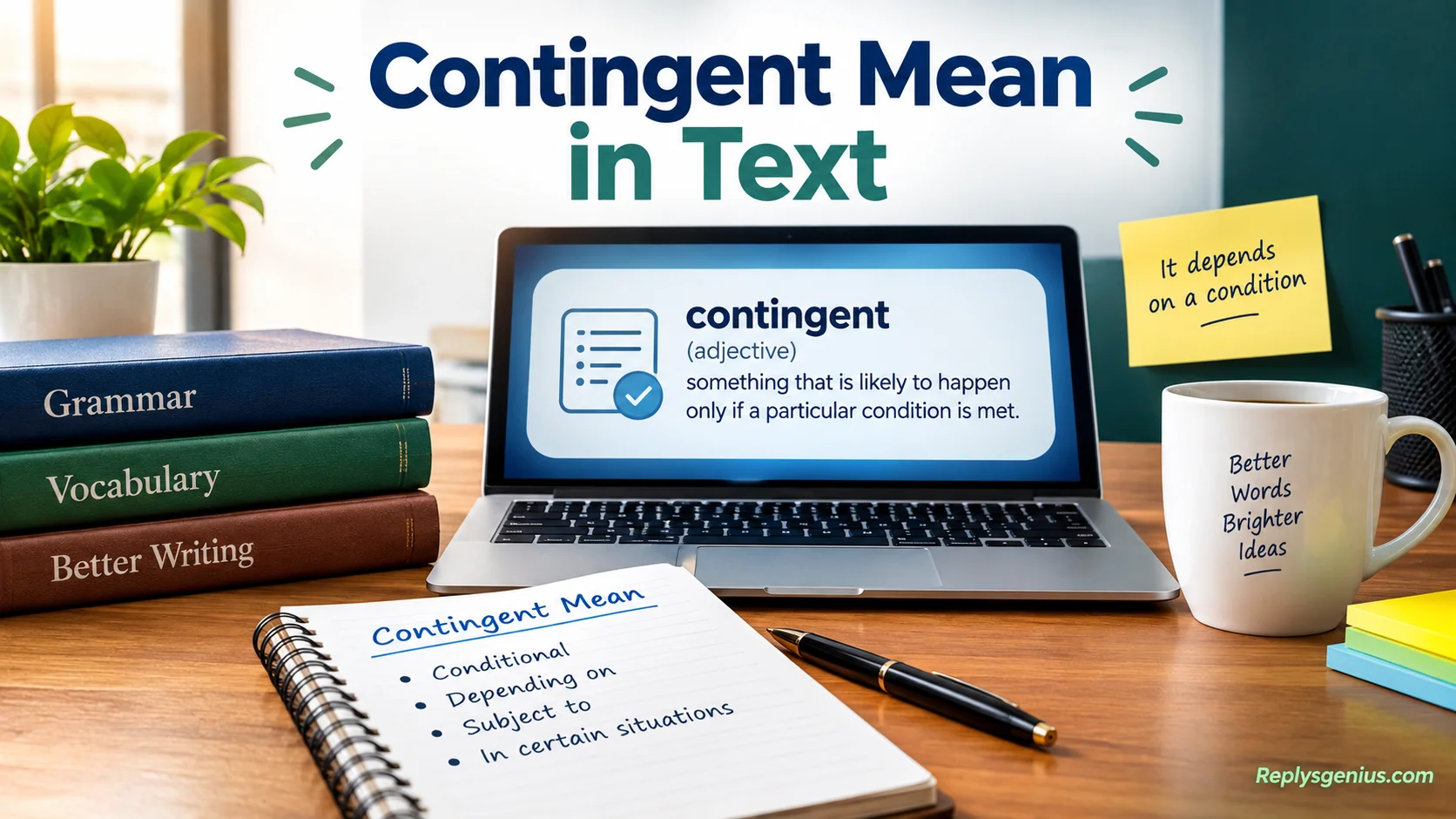
Contingent Mean in Text becomes easier when you see how the word works in real situations, from emails and legal documents to news articles and casual conversations. Although contingent can sound official or intimidating, its straightforward meaning is simple: something is dependent on something else and may or may not happen until certain conditions are met. A job offer may depend on passing a background check, while a contract, plan, event, or situation may only occur when one condition is satisfied first.
The word also has a dual nature, because it can be an adjective meaning dependent or a noun meaning a group of people, such as a contingent of soldiers or a large contingent of fans. The surrounding context usually makes the intended meaning clear, helping you compare contingent with contingency, conditional, and pending. In real estate, a contingent sale can connect a homebuyer’s purchase to another transaction, inspection, financing, or specific requirements.
Since buying a home or buying a house is among the largest purchases people make, understanding these conditions can provide a useful guardrail for buyers during a property transaction. The same idea appears in business and law, where knowing the correct forms, sentence, and context helps you use the word confidently and avoid confusion.
What Does Contingent Mean in Text?
In texting, contingent generally means dependent on something else happening first. When a person says an event or decision is contingent on a condition, they’re saying that the result depends on whether that condition is satisfied.
Consider this message:
“The picnic is contingent on the weather.”
The person doesn’t know whether the picnic will happen. If the weather stays good, it may go ahead. If heavy rain arrives, the plan could change.
The basic formula is easy to remember:
Condition → Decision or outcome
Here are a few everyday examples:
- “Dinner is contingent on when I finish work.”
- “The trip is contingent on getting enough people.”
- “My attendance is contingent on my schedule.”
- “The discount is contingent on buying two items.”
- “The event is contingent on receiving permission.”
In each example, the first thing doesn’t stand completely on its own. Another factor controls what happens next.
Simple Meaning of Contingent
The easiest way to understand contingent is to replace it with “depending on” when the context allows.
For example:
“The offer is contingent on approval.”
This means:
“The offer depends on approval.”
That simple substitution works in many situations.
However, contingent can sound more formal than depending on. That’s why you may encounter it more often in business emails, contracts, employment documents, real-estate listings, and official communication.
A contingent situation isn’t necessarily bad. It simply means the final outcome relies on a condition.
For instance, imagine that a college accepts a student contingent on receiving final transcripts. The student hasn’t necessarily been rejected. The admission simply depends on completing a requirement.
Quick definition
Contingent: dependent on a particular condition, event, or requirement.
A contingent: a group of people sent or organized for a particular purpose.
That second definition matters because the word can change meaning depending on how someone uses it.
What Does Contingent Mean in a Text Message?
When someone uses contingent in a text message, look for the words around it. The surrounding phrase usually reveals exactly what they mean.
The construction “contingent on” or “contingent upon” almost always signals dependence.
For example:
“I’ll join you, contingent on getting off work early.”
Here, joining depends on leaving work early.
Another person might write:
“The game is contingent on enough players showing up.”
That means the game will happen only if enough players participate.
In casual texting, people often choose simpler expressions such as “if,” “depending on,” “as long as,” or “provided that.” Still, someone might use contingent when discussing a serious plan or professional matter.
Common texting patterns
| Text phrase | Plain-English meaning |
| Contingent on approval | Depends on approval |
| Contingent on the weather | Depends on the weather |
| Contingent on funding | Depends on receiving funding |
| Contingent upon completion | Depends on something being completed |
| Contingent on availability | Depends on whether something is available |
So when you see contingent mean in text, don’t automatically interpret it as “maybe.” The word usually points to a specific condition.
Contingent Meaning in Everyday English
In ordinary English, contingent describes something that relies on another circumstance.
Suppose two friends plan a road trip. One friend says:
“I’m in, but the trip is contingent on my car being fixed.”
That statement contains a clear condition. The road trip depends on the car becoming usable.
The distinction matters because contingent doesn’t simply mean uncertain. Something can be uncertain without having a stated condition.
For example:
- “The result is uncertain.” → The outcome isn’t known.
- “The result is contingent on approval.” → The outcome depends on approval.
The second sentence gives you a reason for the uncertainty.
That’s one of the most useful clues when reading the word.
Contingent vs. Conditional: What’s the Difference?
Contingent and conditional overlap heavily, but they aren’t always identical in tone or usage.
Conditional generally describes something that applies only when a particular condition is met. Contingent often emphasizes that an outcome depends on another event or circumstance.
| Word | Core idea | Example |
| Contingent | Dependent on something | “The offer is contingent on approval.” |
| Conditional | Applies if a condition is met | “The agreement is conditional on approval.” |
| Dependent | Reliant on something else | “The result is dependent on funding.” |
In many sentences, contingent and conditional can communicate nearly the same idea.
However, context matters. You shouldn’t assume every synonym can replace the original word without changing the tone or meaning.
A legal document may use “contingent upon” because it clearly connects an obligation or event to a specified condition. In a casual text, “if” might sound much more natural.
Contingent Meaning in Work and Employment
The phrase contingent worker has a specific workplace meaning. It generally refers to someone who works under a non-permanent employment arrangement, such as certain temporary, contract, freelance, or on-demand roles.
The exact classification depends on the employment arrangement and applicable law. Not every contractor, freelancer, or temporary worker has identical rights or responsibilities.
A company might use contingent workers when it needs extra help for:
- A short-term project
- Seasonal demand
- Specialized expertise
- Temporary staffing needs
- A specific contract
- A limited-duration assignment
For example, a company launching a new website might hire a developer for a six-month project. That person may work as part of the project team without becoming a permanent employee.
The term therefore has a different meaning from “contingent on approval.” In contingent worker, contingent describes the nature of the work arrangement. It doesn’t mean the person is waiting for a condition to happen.
What Is a Contingent Worker?
A contingent worker is generally someone hired through a work arrangement that doesn’t follow the traditional permanent employee model.
Depending on the arrangement, a contingent worker could be:
- A temporary worker
- An independent contractor
- A freelancer
- A project-based specialist
- Certain workers supplied through staffing agencies
The exact legal status matters. Calling someone a contingent worker doesn’t automatically determine whether that person is legally an employee or independent contractor.
Workplace example
Imagine a company needs a cybersecurity specialist for a three-month security project.
A manager might say:
“We’re bringing in a contingent cybersecurity specialist for the project.”
Here, contingent describes the worker’s arrangement rather than a condition attached to the specialist’s hiring.
That’s an important distinction for readers who encounter the term in job advertisements.
What Does a Contingent Job Mean?
A contingent job generally refers to work that isn’t structured as a traditional permanent position.
The job may have a defined duration, project scope, or flexible arrangement. However, the precise terms vary by employer.
For example:
“This is a six-month contingent position.”
That tells you the position is structured around a limited work arrangement. It doesn’t necessarily tell you everything about benefits, taxes, scheduling, or employment classification.
Before accepting such a role, it’s useful to check:
- Who employs you?
- How long does the assignment last?
- Is the position renewable?
- How are you paid?
- Are benefits included?
- What hours are expected?
- What happens when the project ends?
The word contingent describes the broad arrangement. The actual contract supplies the important details.
Contingent Offer Meaning
A contingent offer is an offer that depends on one or more conditions being satisfied.
The phrase appears in several settings. A job offer might be contingent on completing a background check. A real-estate offer might depend on financing or a successful inspection.
For example:
“Your employment offer is contingent upon completion of the background check.”
The employer has made an offer, but a stated condition still needs to be completed.
This distinction prevents a common misunderstanding. Contingent doesn’t automatically mean fake, canceled, or rejected. It means the offer has a condition attached to it.
Common conditions
A contingent offer might depend on:
- Background verification
- Required documentation
- Financing
- Approval from another party
- Completion of a qualification
- Successful inspection
- Satisfying a contractual requirement
Always read the specific terms because the condition determines what contingent means in that particular situation.
Contingent Meaning in Real Estate
Real estate uses contingent frequently.
When a home listing or purchase offer shows a contingent status, it generally means an offer has been made and one or more conditions still need to be resolved before the transaction can move forward.
Common real-estate contingencies include:
| Contingency | What it generally means |
| Inspection | The buyer may require an acceptable inspection result. |
| Financing | The purchase depends on obtaining financing. |
| Appraisal | The transaction may depend on the property meeting an appraisal requirement. |
| Sale of another property | The buyer may need to sell another home first. |
Real-estate terminology can vary by market and listing service. Therefore, a listing marked contingent doesn’t tell you every detail of the agreement.
What does contingent mean on a house listing?
In simple terms, it usually means the seller has accepted or is working with an offer that includes unresolved conditions.
For example, a buyer could offer $350,000 for a house while making the purchase contingent on a satisfactory inspection.
If the inspection identifies a serious problem, the contract may give the buyer certain rights. Those rights depend on the actual agreement.
Contingent vs. Pending in Real Estate
Contingent and pending aren’t interchangeable in real estate.
A contingent transaction generally still has one or more conditions that need to be resolved. Pending usually indicates that the transaction has progressed further and is awaiting closing, although definitions and listing practices can vary.
Think of it like a checklist.
Contingent:
“We have an offer, but condition X still needs attention.”
Pending:
“The deal has progressed further and is awaiting completion.”
The exact status rules depend on the local market and listing service. When money or property is involved, the listing label shouldn’t replace reviewing the actual contract.
Contingent Meaning in Legal Terms
Legal documents often use contingent to connect an obligation, right, payment, or event to a specific condition.
One common phrase is:
“Contingent upon”
For example:
“Payment is contingent upon completion of the work.”
The plain meaning is that completion must occur before the stated payment obligation is triggered under the relevant agreement.
Legal language can become much more precise than everyday English. A contract may define what counts as completion, who decides whether the condition was satisfied, and what happens if it wasn’t.
That’s why the phrase “contingent upon” shouldn’t be interpreted in isolation when reading an actual contract.
What does “contingent upon” mean?
Contingent upon means dependent on a particular condition.
Examples include:
- “Approval is contingent upon receiving the required documents.”
- “Payment is contingent upon successful delivery.”
- “Participation is contingent upon meeting the eligibility requirements.”
The condition after upon tells you what must happen.
Contingent Meaning in Business and Contracts
Businesses use contingent when they need to describe outcomes that depend on future events or requirements.
You may see it in:
- Contracts
- Purchase agreements
- Vendor arrangements
- Employment documents
- Project plans
- Payment terms
- Business negotiations
Consider this sentence:
“The additional payment is contingent on completing the project by June 30.”
The payment isn’t described as automatic. Its availability depends on the stated condition.
This type of wording helps businesses distinguish between an unconditional commitment and one that requires something else to happen.
A practical business example
A marketing agency agrees to pay a bonus if a campaign reaches a defined sales target.
The agreement might state:
“The performance bonus is contingent upon achieving the agreed sales target.”
The word tells the reader that the bonus depends on the target being achieved.
Contingent Meaning in Finance
Finance uses contingent to describe situations where an obligation or outcome depends on a future event.
One important example is a contingent liability.
A contingent liability isn’t simply an ordinary bill that a company definitely owes. Instead, its existence or amount can depend on an uncertain future event.
For example, a company facing a lawsuit may have a potential obligation depending on the outcome of the case.
The accounting treatment of contingent liabilities involves specific recognition and disclosure rules. Under U.S. GAAP, for example, the accounting depends on factors such as the likelihood of the loss and whether the amount can be reasonably estimated.
The key idea for a general reader remains straightforward:
A contingent financial obligation depends on an uncertain event or condition.
What Is a Contingent Liability?
A contingent liability is a potential obligation that depends on a future event.
A simple example involves litigation.
Imagine Company A is being sued. The company doesn’t automatically owe the plaintiff the claimed amount merely because the lawsuit exists. The eventual obligation may depend on the court outcome or settlement.
Other situations can involve guarantees, disputes, or other uncertain events.
The important distinction is:
Existing debt: The company already has a recognized obligation.
Contingent liability: The potential obligation depends on circumstances that haven’t been resolved.
Financial reporting rules determine how such matters should be handled.
What Does Contingent Mean When Referring to a Group of People?
Here’s where the word takes a completely different turn.
A contingent can mean a group of people representing a particular organization, team, country, or purpose.
For example:
“A large contingent of students attended the conference.”
Here, contingent doesn’t mean “dependent on.” It means group.
Another example:
“The country sent a contingent of athletes to the competition.”
The word refers to the group of athletes representing that country.
You may encounter this usage in news reports, sports coverage, conferences, military contexts, and formal descriptions of delegations.
Contingent as a noun
| Sentence | Meaning |
| “A contingent of fans arrived early.” | A group of fans |
| “A contingent of athletes traveled abroad.” | A group of athletes |
| “The conference welcomed a large contingent of students.” | A group of students |
| “A military contingent was deployed.” | A group of military personnel |
Context makes the distinction clear.
Contingent vs. Contingency
These words are related but serve different grammatical roles.
Contingent can function as an adjective meaning dependent on something. It can also function as a noun meaning a group.
Contingency is a noun describing a possible future event, condition, or situation that may require action.
For example:
“The project is contingent on funding.”
Here, contingent describes the project.
Now consider:
“The team created a contingency plan.”
Here, contingency refers to a possible situation that the team wants to prepare for.
Easy comparison
| Word | Meaning | Example |
| Contingent | Dependent on something | “The event is contingent on funding.” |
| Contingency | Possible future situation | “We created a contingency plan.” |
A useful memory trick is this:
Contingent = depends.
Contingency = possible situation.
Contingent vs. Dependent
Dependent is one of the closest everyday alternatives to contingent.
Compare these sentences:
“The event is dependent on funding.”
“The event is contingent on funding.”
Both tell the reader that funding affects whether the event can happen.
The difference is mainly one of tone and context. Dependent works naturally in everyday speech. Contingent often sounds more formal or technical.
For example, a friend might say:
“The trip depends on the weather.”
A business document might say:
“The trip is contingent upon favorable weather conditions.”
The underlying idea remains similar.
Read More: NFS Mean in Text: What Does NFS Mean?
Common Phrases With Contingent
Learning common phrases makes the word much easier to recognize.
Contingent on
Means dependent on.
“The decision is contingent on management approval.”
Contingent upon
Also means dependent on and often sounds more formal.
“The agreement is contingent upon completion of the inspection.”
Contingent offer
An offer that depends on specified conditions.
“The buyer submitted a contingent offer.”
Contingent worker
A worker in a nontraditional or non-permanent work arrangement.
“The company hired several contingent workers.”
Contingent employment
Employment structured around a temporary, project-based, or other nontraditional arrangement.
Contingent liability
A potential financial obligation that depends on a future event.
Contingent payment
Payment that depends on a specified condition being satisfied.
Contingent agreement
An agreement whose effect or obligation depends on stated conditions.
The phrase following contingent often provides the most important clue.
How to Use Contingent in a Sentence
The most common structure is:
Subject + is/are + contingent on/upon + condition
Examples:
“The event is contingent on receiving permission.”
“The launch is contingent upon final approval.”
“My attendance is contingent on my work schedule.”
The word can also work as a noun:
“A large contingent of fans attended the game.”
Notice the grammatical difference.
In the first examples, contingent describes something that depends on a condition. In the last example, contingent refers to a group.
Casual example
“The beach trip is contingent on the weather.”
Meaning: The trip depends on the weather.
Professional example
“The promotion is contingent upon completing the required training.”
Meaning: Completing the training is a requirement for the promotion under the stated terms.
Group example
“A large contingent of students attended the conference.”
Meaning: A large group of students attended.
Examples of Contingent in Text Messages
Realistic examples help show how people understand the word in conversation.
| Situation | Text | What it means |
| Plans | “Dinner is contingent on my schedule.” | Dinner depends on availability. |
| Travel | “The trip is contingent on the weather.” | Weather may determine whether it happens. |
| Work | “The offer is contingent on approval.” | Approval must happen first. |
| School | “The trip is contingent on permission.” | Permission is required. |
| Money | “Payment is contingent on delivery.” | Delivery must occur first. |
| Event | “The concert is contingent on enough tickets selling.” | Ticket sales affect whether it happens. |
| Housing | “The purchase is contingent on financing.” | Financing is a condition of the purchase. |
Short text conversation
Alex: “Are you coming Saturday?”
Jordan: “Probably. It’s contingent on whether I can switch shifts.”
Jordan isn’t giving a definite yes. The answer depends on changing the work schedule.
That is the everyday heart of contingent meaning.
Case Study: Understanding a Contingent Job Offer
Imagine Maya receives an email from a company after a successful interview.
The message says:
“We’re pleased to offer you the position. Your employment is contingent upon successful completion of the background check.”
At first glance, Maya might wonder whether she has actually received the job.
The important phrase is “contingent upon.” The company has made an offer, but the stated condition still matters.
The situation can be understood like this:
Job offer → Background check → Employment proceeds if the condition is satisfied
The word doesn’t automatically tell Maya what the background-check policy is or what happens if an issue appears. Those details belong to the employer’s actual terms.
The lesson is useful beyond employment: whenever you see contingent upon, look immediately after it. That’s where you’ll usually find the condition.
Case Study: Understanding a Contingent Home Offer
Suppose Daniel wants to buy a home. He submits an offer that includes an inspection contingency.
The seller accepts the offer subject to the agreement’s terms.
The word contingent tells Daniel that the transaction still has a condition attached. The inspection may reveal problems that affect what happens next.
A simplified sequence looks like this:
Offer → Inspection → Condition resolved → Transaction progresses
The exact rights of the buyer and seller depend on the purchase agreement and applicable local rules.
This example shows why contingent doesn’t mean canceled. It means the transaction remains tied to a condition.
Common Mistakes When Using Contingent
The word looks complicated, but most mistakes come from a few simple misunderstandings.
Mistake: Thinking contingent always means “maybe”
A contingent situation involves uncertainty, but the key idea is dependence on a condition.
Instead of simply saying:
“It might happen.”
Think:
“It can happen if this condition is satisfied.”
Mistake: Confusing contingent with pending
Pending means something is waiting for completion or a decision. Contingent emphasizes a condition that affects the outcome.
Mistake: Assuming contingent means rejected
A contingent offer or plan can still move forward. The condition simply hasn’t been resolved.
Mistake: Ignoring the context
“Contingent worker” and “contingent on approval” use the same word differently.
Mistake: Treating synonyms as exact replacements
Words such as conditional, dependent, and possible overlap with contingent. However, they don’t work identically in every sentence.
How to Understand Contingent From Context
When you’re unsure about contingent meaning in text, use the words surrounding it.
| If you see… | It probably means… |
| “Contingent on approval” | Dependent on approval |
| “Contingent upon completion” | Dependent on completion |
| “Contingent worker” | Nontraditional or temporary work arrangement |
| “Contingent offer” | Offer with conditions |
| “Contingent liability” | Potential obligation depending on a future event |
| “A contingent of fans” | A group of fans |
| “Contingent on funding” | Depends on funding |
This approach is faster than memorizing a dictionary definition for every possible use.
Look at the noun after contingent. Then check whether the word appears with on or upon.
If you see “contingent on”, you’re almost certainly dealing with the depends-on meaning.
If you see “a contingent of”, you’re probably looking at the group meaning.
Is Contingent a Formal or Casual Word?
Contingent works in both everyday and formal English, but it appears more frequently in professional or technical settings.
A friend might naturally text:
“The trip depends on the weather.”
A manager might write:
“The trip is contingent upon favorable weather conditions.”
Both sentences communicate essentially the same idea. The second simply has a more formal tone.
You’ll especially encounter contingent in:
- Business communication
- Legal documents
- Employment agreements
- Real-estate listings
- Financial reporting
- Academic writing
- Government or organizational communication
In casual texting, don’t force the word into every sentence. If “it depends” sounds more natural, use it.
Good communication isn’t about choosing the longest word. It’s about choosing the clearest one.
Synonyms for Contingent
The best synonym depends on which meaning you’re trying to express.
When contingent means “dependent”
Useful alternatives include:
- Dependent
- Conditional
- Subject to
- Based on
- Determined by
- Reliant on
- Depending on
Example:
“The payment is contingent on delivery.”
Possible rewrite:
“The payment depends on delivery.”
When contingent refers to a possible situation
Depending on context, related words may include:
- Possible
- Potential
- Uncertain
These aren’t always direct replacements.
When contingent means “group”
Possible alternatives include:
- Group
- Team
- Delegation
- Party
For example:
“A contingent of athletes attended.”
Could become:
“A group of athletes attended.”
The correct replacement depends entirely on the sentence.
When Should You Use Contingent in Texting?
Use contingent when you want to make a dependency clear, especially in professional or serious conversations.
When to use it
- When an outcome depends on a specific condition.
- When discussing plans that require approval.
- When explaining requirements.
- When talking about offers or agreements.
- When communicating about work or business.
- When a precise term helps avoid confusion.
For example:
“The meeting is contingent on the client’s availability.”
That’s clear and professional.
When not to use it
You don’t need contingent when a simpler phrase sounds more natural.
Instead of:
“My arrival is contingent upon my transportation situation.”
A casual text could simply say:
“I’ll come if I can find a ride.”
The second version feels more human in everyday conversation.
Contingent Meaning in Different Contexts at a Glance
The word becomes much easier once its major uses sit side by side.
| Context | Meaning of contingent | Example |
| Texting | Depends on something | “The plan is contingent on the weather.” |
| Work | Nontraditional work arrangement | “She’s a contingent worker.” |
| Employment | Job arrangement that may be temporary or project-based | “It’s a contingent position.” |
| Real estate | Offer with unresolved conditions | “The home is under a contingent offer.” |
| Legal | Dependent on a specified condition | “Payment is contingent upon completion.” |
| Finance | Potential obligation tied to a future event | “The company reported a contingent liability.” |
| Group | A group representing a larger organization | “A contingent of athletes attended.” |
This table captures the main meanings without treating them as interchangeable.
FAQs
1. What does Contingent Mean in Text?
Contingent Mean in Text usually means dependent on something else. It describes something that may or may not happen because it depends on certain conditions being met first. For example, a job offer can be contingent on passing a background check.
2. Can contingent mean a group of people?
Yes. Contingent can also be a noun meaning a group of people. For example, a contingent of soldiers means a group of soldiers, while a large contingent of fans refers to a large group of fans.
3. What is a contingent sale in real estate?
A contingent sale is a real estate transaction that depends on specific conditions being satisfied. These may involve financing, an inspection, another transaction, or other requirements before the deal can move forward.
4. Is contingent the same as conditional?
They are closely related, but they are not always interchangeable. Contingent generally means something depends on another event or condition, while conditional describes something that is subject to a particular condition or requirement.
5. What is the difference between contingent and contingency?
Contingent can function as an adjective meaning dependent on something else and as a noun meaning a group of people. Contingency is generally the possibility of a future event or a condition that must be considered in a plan, contract, or situation.
Conclusion
Understanding contingent becomes easier when you focus on the context. In its most common form, it means dependent on something else, while its noun form can describe a group of people. You may see it in emails, legal documents, business, law, news articles, and real estate. Recognizing whether it is being used as an adjective or noun helps you understand the intended meaning quickly.
In everyday situations, remember the simple idea: something contingent depends on something else before it can happen. Whether you are reading about a job offer, contract, property transaction, or contingent sale, identifying the related conditions makes the meaning much clearer. With a little practice, you can use contingent, contingency, conditional, and pending more confidently and accurately.