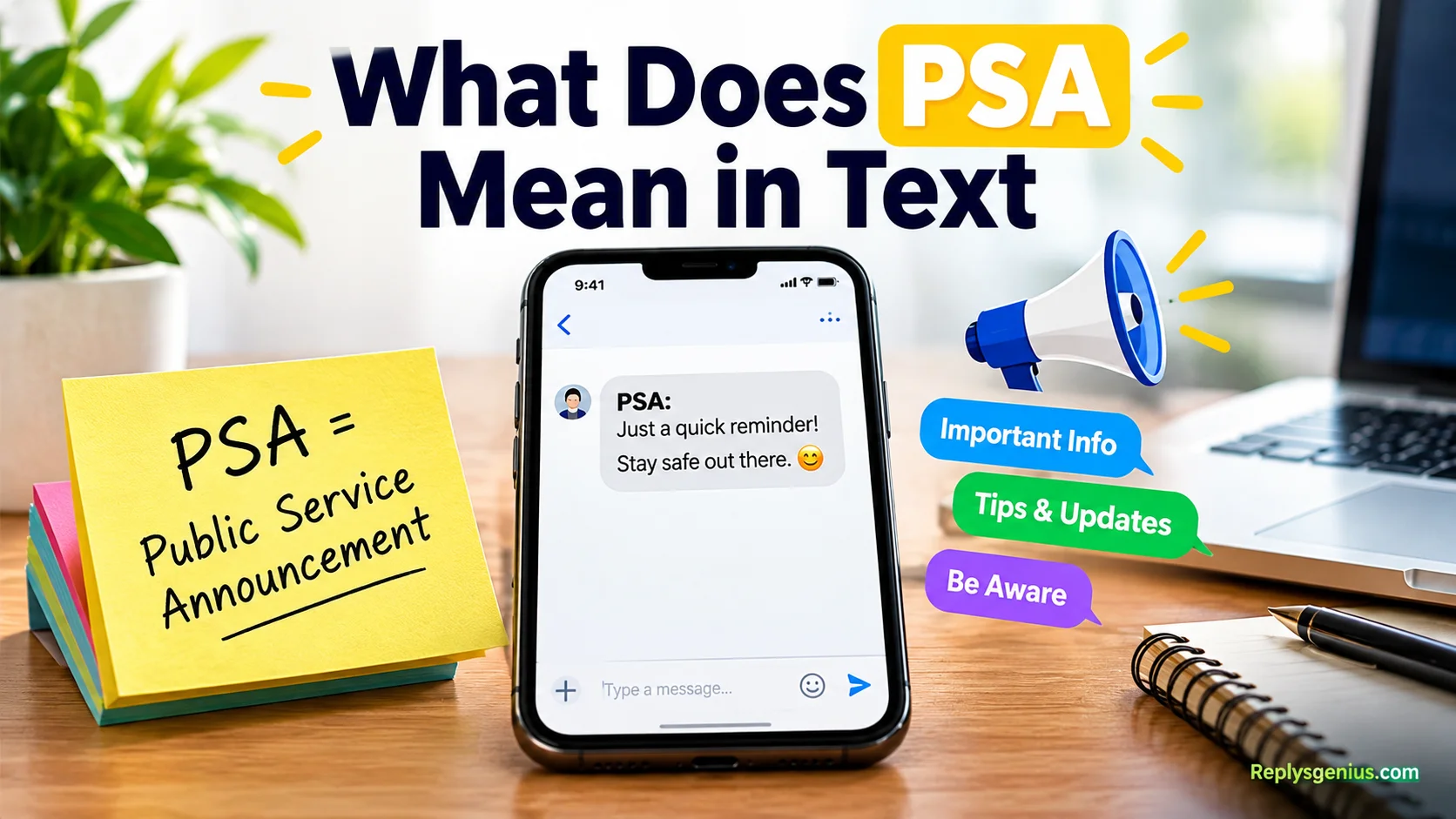
What Does PSA Mean in Text? It means Public Service Announcement, used online to share important information, warnings, reminders, or helpful advice. When you’re texting, scrolling, or chatting online, PSA works as a common abbreviation that appears in messages, captions, comments, and online messaging. Its full meaning is Public Service Announcement, but internet slang has given it a more casual style. People use it to share something everyone needs to know, such as a quick warning, important advice, or helpful information. Unlike an official announcement, a PSA can be attention-grabbing, dramatic, or less formal. From my experience with online language, this flexible style is one reason the term feels natural in everyday chats.
The meaning can depend on the situation, speaker, and different platforms. A PSA may sound serious, funny, or sarcastic, especially on social media and in chats on WhatsApp, TikTok, Instagram, Snapchat, and X. PSA meaning in text is closely linked to online conversations and social media trends, where users may introduce a useful fact, a dramatic opinion, or playful advice. The tone is often clear from the surrounding words, so readers can understand whether the person is genuinely informing others or simply being playful.
Understanding where it came from adds useful context. The phrase originally described public messages created to inform people, but online users have adapted it for everyday communication. For examples, a friend might use PSA before posting a warning, sharing advice, or highlighting something everyone needs to know. If someone sends you a PSA, you can reply naturally by acknowledging it or asking for more details. Learning these abbreviations, their different meanings, and common mistakes makes online language easy to understand.
What Does PSA Mean in Text?
In texting and most social media conversations, PSA stands for “Public Service Announcement.” People place it before information that they want a group or audience to notice.
The original phrase has a more formal meaning. A public service announcement traditionally communicates information that benefits or informs the public. These announcements can cover topics such as safety, health, emergencies, education, or community awareness.
Online communication has given the abbreviation a more casual life.
When someone writes:
PSA: Don’t forget your umbrella tomorrow.
They’re usually not claiming to represent a public agency. They’re simply saying, “Here’s something you should know.”
That makes PSA especially useful in group chats and social media. It acts almost like a headline before the actual message.
PSA Meaning in Text at a Glance
| Term | Meaning | Common Use |
| PSA | Public Service Announcement | Important information, reminders, warnings, or advice |
| FYI | For Your Information | Sharing information with someone |
| PS | Postscript | Adding an extra thought to a message |
| BTW | By the Way | Introducing an additional point |
| IMO | In My Opinion | Introducing a personal opinion |
The key idea is simple: PSA tells you to pay attention to what comes next.
What Does PSA Stand For?
PSA stands for “Public Service Announcement.” The phrase describes a message created to inform or educate the public about something important.
Traditional PSAs have appeared in television broadcasts, radio programs, posters, public campaigns, websites, and other forms of mass communication. Topics often involve public safety, health awareness, education, and community information.
Digital communication shortened the phrase into something much more flexible.
Today, a person can write “PSA” before a two-line message to friends. The message doesn’t need to involve a government agency, nonprofit organization, or formal campaign. The abbreviation simply borrows the idea of a public announcement.
Why Do People Use PSA Instead of Writing the Full Phrase?
Three letters are faster than typing Public Service Announcement every time.
More importantly, PSA creates an expectation. When readers see it, they know the following information is supposed to matter to them.
Compare these two messages:
- “The gym closes at 5 today.”
- “PSA: The gym closes at 5 today.”
The basic information remains the same. However, the second version sounds more like a notice intended for a group.
That small difference explains why PSA works so well in texting culture.
How PSA Is Used in Text Messages
People commonly use PSA in text messages when they want to share something useful with several people. It can introduce a reminder, correction, warning, recommendation, or important update.
For example:
“PSA: The meeting starts at 9 instead of 10 tomorrow.”
Here, PSA tells everyone reading the message that the schedule change deserves attention.
You might also see it used for everyday advice:
“PSA: Charge your phone before leaving for the airport.”
Or for a simple discovery:
“PSA: The new episode is already available.”
The message doesn’t need to be dramatic. In fact, casual use is one of the biggest reasons PSA has become popular in online language.
Common Reasons People Use PSA in Texts
- Reminders: “PSA: Your appointment is tomorrow.”
- Warnings: “PSA: That road is closed today.”
- Updates: “PSA: The deadline moved to Friday.”
- Advice: “PSA: Save your work before updating the app.”
- Recommendations: “PSA: This restaurant takes reservations online.”
- Corrections: “PSA: The event starts at 7, not 8.”
- Helpful discoveries: “PSA: You can get free delivery today.”
In each case, the abbreviation frames the following sentence as information worth noticing.
PSA Meaning on Social Media
On social media, PSA often works like a mini headline.
A creator may use it at the beginning of a caption, post, comment, or video description to draw attention to a specific point. The audience could be friends, followers, customers, classmates, or a much larger online community.
For example:
“PSA: Check your privacy settings before sharing personal information online.”
The writer isn’t necessarily making a formal public announcement. They’re using familiar language to tell readers, “This is worth knowing.”
Social media also gives PSA a humorous side.
Someone might post:
“PSA: Coffee tastes better when someone else makes it.”
That’s not a traditional public service message. It’s a playful statement presented in the style of an announcement.
Why PSA Works So Well on Social Platforms
Social media feeds move quickly. Users often skim rather than read every word carefully.
Putting PSA at the beginning gives the reader a clear signal:
Attention → Information → Takeaway
That structure makes the message easy to scan.
It also creates a recognizable tone. Depending on the content, the post can sound informative, dramatic, funny, sarcastic, or friendly.
PSA in Group Chats
Group chats are one of the most natural places to use PSA.
Imagine a group of friends planning a weekend trip. Someone discovers that the train schedule changed and sends:
“PSA: The 8:30 train isn’t running Saturday. We need the 9:15.”
The abbreviation immediately tells the group that the information affects their plans.
It can work just as well in a family chat:
“PSA: Mom’s birthday dinner starts at 7, not 6.”
Or in a school group:
“PSA: The project deadline is Friday at midnight.”
The important factor isn’t the subject. It’s the purpose of the message. PSA works when the sender wants a group to notice information.
Common Examples of PSA in Texting
The easiest way to understand PSA meaning in texting is to look at realistic examples.
| Text Example | Purpose | Tone |
| “PSA: The store closes at 6 today.” | Reminder | Informative |
| “PSA: Bring a jacket tonight.” | Advice | Friendly |
| “PSA: The deadline moved to Friday.” | Update | Serious |
| “PSA: That movie has a post-credit scene.” | Helpful information | Casual |
| “PSA: Don’t forget your charger.” | Reminder | Friendly |
| “PSA: The parking lot is closed today.” | Warning | Informative |
| “PSA: The new episode is out.” | Announcement | Excited |
| “PSA: Water before coffee.” | Advice | Playful |
Notice how the meaning stays the same even though the subjects change.
PSA signals the function of the message rather than the topic.
How to Understand PSA From Context
Context matters whenever you encounter an abbreviation.
If someone writes “PSA: The exam has moved to Monday,” the meaning is obvious because the sentence describes an announcement.
However, PSA can have other meanings in specialized settings. That’s why you shouldn’t automatically assume that every occurrence means Public Service Announcement.
Consider the conversation around the abbreviation.
Ask yourself:
- Is this a casual text?
- Is someone addressing a group?
- Does the message contain a reminder or warning?
- Is it a social media post?
- Is the discussion about medicine or another specialized subject?
- Does the phrase introduce information intended for other people?
If the conversation is casual and PSA appears before a general announcement, Public Service Announcement is usually the intended meaning.
If the discussion involves medical testing, however, PSA can refer to prostate-specific antigen, which is a completely different term.
Context is the deciding factor.
Is PSA Always Serious in Texting?
No. PSA can sound serious, casual, humorous, or sarcastic.
The abbreviation itself doesn’t determine the tone. The words that follow it do.
A serious message might say:
“PSA: Never share your account password with someone who contacts you unexpectedly.”
A casual message could say:
“PSA: The bakery has fresh cinnamon rolls today.”
A humorous version might read:
“PSA: Pizza is a perfectly reasonable breakfast.”
The last example deliberately borrows the formal sound of an announcement for something trivial.
That’s part of the fun.
Online communication frequently takes formal language and places it in everyday situations. PSA is a perfect example of that shift.
PSA vs. Announcement
The words PSA and announcement overlap, but they aren’t identical in everyday communication.
An announcement simply tells people about something.
A PSA usually emphasizes information that the audience should notice, know, or act on.
Compare:
Announcement:
“The office will close at 4 p.m.”
PSA:
“PSA: The office closes at 4 p.m. today, so pick up your documents before then.”
The first sentence gives information. The second highlights the practical consequence.
That doesn’t mean PSA always carries greater importance. People often use it casually. Still, the abbreviation tends to create an attention-grabbing frame around the message.
PSA vs. FYI
FYI means “For Your Information.” It’s another common abbreviation used when sharing information.
So what’s the difference between PSA and FYI?
FYI often feels more direct and personal. Someone might send:
“FYI, the manager moved the meeting to Thursday.”
PSA sounds more like an announcement directed toward an audience:
“PSA: The meeting moved to Thursday.”
The distinction isn’t absolute. People sometimes use the two interchangeably.
Still, their typical conversational functions differ:
| PSA | FYI |
| Public Service Announcement | For Your Information |
| Often addresses a group or audience | Often addresses one person or a smaller group |
| Can sound attention-grabbing | Usually sounds informational |
| Often introduces advice, warnings, or reminders | Usually introduces information |
| Can be serious or playful | Usually neutral |
Think of FYI as “here’s information” and PSA as “here’s something everyone should notice.”
PSA vs. PS
PSA and PS look similar, but they mean very different things.
PS means postscript. People use it to add something after the main message.
For example:
“I’ll send the documents tonight. PS: Don’t forget the attachment.”
PSA doesn’t add a final thought. Instead, it usually introduces the main information:
“PSA: Don’t forget the attachment.”
A useful shortcut is:
- PS = extra thought after the message
- PSA = announcement or attention-grabbing information
Confusing the two can completely change the structure of a message.
When Should You Use PSA in a Text?
You can use PSA in texting when you want to make useful information stand out.
It works particularly well when the information affects several people.
Good Situations for PSA
- A schedule has changed.
- You want to remind a group about a deadline.
- You discovered something useful.
- You need to warn people about a problem.
- You want to share a practical tip.
- You want to correct misinformation.
- You’re posting advice for a broader audience.
- You want to make a casual announcement.
For example:
“PSA: Back up your phone before installing the update.”
The message is short, useful, and audience-focused. PSA fits naturally.
When Should You Avoid Using PSA?
Although PSA is flexible, it doesn’t belong in every message.
Using it for every tiny statement can make your writing sound exaggerated.
For instance:
“PSA: I’m going to make a sandwich.”
That could be funny between friends. In a serious workplace conversation, however, it would probably feel out of place.
You should also avoid PSA when you’re writing highly formal communication unless the style specifically calls for it. A professional announcement may be clearer when you simply state the information directly.
The goal isn’t to make every message sound important.
Use PSA when the message benefits from an attention signal.
How to Use PSA Correctly in a Sentence
The most common structure is simple:
PSA: + information
Examples:
- “PSA: The library closes early today.”
- “PSA: Submit your application before Friday.”
- “PSA: Don’t leave valuables in your car.”
A colon usually works well after PSA because it introduces the announcement.
You can also use it naturally in a longer social media caption:
“PSA: If you’re traveling this weekend, check the road conditions before leaving.”
Capitalization can vary in informal writing. However, PSA in uppercase remains the clearest and most recognizable form.
Read More: YK Meaning in Text: What Does YK Mean in Texting?
PSA Examples for Different Situations
The meaning stays consistent across different environments, but the subject changes with the audience.
PSA in a Text to Friends
Friends might use PSA for plans, reminders, recommendations, or funny observations.
“PSA: Bring cash. The food truck doesn’t take cards.”
It’s brief and practical.
PSA in a Family Group Chat
Family members can use PSA for schedules and household reminders.
“PSA: The doctor’s appointment is at 10 tomorrow.”
The message helps everyone notice the relevant information.
PSA at School
Students may use PSA in group chats to share deadlines or schedule changes.
“PSA: The science project is due Friday.”
Teachers and official school communications might use more formal wording, but students commonly use PSA casually.
PSA at Work
In workplace chats, PSA can introduce a useful reminder:
“PSA: Please submit your timesheets before the end of the day.”
However, tone matters. If the workplace uses formal communication standards, “Reminder” or “Please note” may sound more appropriate.
PSA on Instagram, TikTok, or X
Social media users often turn PSA into a hook:
“PSA: Read the return policy before buying online.”
The short format works well because users can understand the purpose of the post almost instantly.
Funny and Casual PSA Examples
Internet users often use PSA humor by treating ordinary opinions like major public announcements.
Here are a few examples:
- “PSA: Fries taste better when you steal them from someone else.”
- “PSA: The weekend isn’t long enough.”
- “PSA: Never underestimate a five-minute nap.”
- “PSA: Your favorite song always sounds better at night.”
- “PSA: Pizza leftovers deserve respect.”
These aren’t actual public service announcements. The humor comes from the contrast between the formal phrase and the ordinary subject.
This style has become common because it makes a short post feel more dramatic and memorable.
Can PSA Sound Rude or Condescending?
PSA itself isn’t rude. The wording and situation determine how the message comes across.
For example:
“PSA: Please check the schedule before coming in.”
This could sound like a helpful reminder.
Now consider:
“PSA: Some of you clearly don’t know how schedules work.”
The second version can sound mocking or condescending.
The difference isn’t the abbreviation. It’s the attitude behind the sentence.
If you’re using PSA in a workplace or group setting, keep the wording neutral when the subject is sensitive. A helpful tone usually works better than making people feel singled out.
What Does PSA Mean in Different Contexts?
The most common interpretation depends heavily on where you encounter it.
| Context | Likely Meaning | Example |
| Texting | Public Service Announcement | “PSA: Meeting starts at 9.” |
| Group chat | Public Service Announcement | “PSA: Bring your ID.” |
| Social media | Public Service Announcement | “PSA: Check the ingredients.” |
| Workplace chat | Public Service Announcement | “PSA: Submit reports today.” |
| School chat | Public Service Announcement | “PSA: The deadline changed.” |
| Medical discussion | Prostate-specific antigen | “The doctor ordered a PSA test.” |
This distinction is important.
In a casual Instagram caption, PSA almost certainly means Public Service Announcement. In a medical conversation involving blood tests or prostate health, the abbreviation may mean something entirely different.
Other Meanings of PSA
Although Public Service Announcement is the common meaning in casual online communication, PSA has other established uses.
One important medical meaning is prostate-specific antigen.
PSA is a protein produced by cells in the prostate. Medical professionals can measure PSA levels through a blood test. PSA testing can be part of discussions about prostate health, including prostate cancer screening and monitoring.
That meaning has nothing to do with online announcements.
There are also specialized uses in different industries and organizations. However, they aren’t automatically relevant when someone uses PSA in an ordinary text.
The surrounding words usually provide the answer.
Public Service Announcement vs. Prostate-Specific Antigen
These meanings are easy to separate once you look at the context.
“PSA: The parking lot closes at 8.”
Here, PSA clearly introduces an announcement.
“My doctor wants to discuss my PSA level.”
Here, the medical context points to prostate-specific antigen.
When an abbreviation has multiple meanings, don’t interpret the letters in isolation. Read the entire sentence.
How to Tell Which PSA Meaning Someone Intended
When you see PSA, use a few simple clues.
Look at the Topic
If the message discusses schedules, reminders, social media, or public information, Public Service Announcement is likely.
If it discusses laboratory results, doctors, prostate health, or medical testing, another meaning may apply.
Look at the Sentence Structure
A message beginning with:
“PSA: …”
usually uses PSA as an announcement label.
A sentence such as:
“My PSA level was…”
may use PSA as a medical term.
Consider the Audience
A group-chat message usually uses PSA in the casual announcement sense.
A medical conversation uses specialized terminology differently.
Context turns three ambiguous letters into a clear meaning.
Realistic PSA Text Conversation Examples
Example: Group Chat Reminder
Alex: “Are we still meeting at 6?”
Jordan: “Yep. PSA: The restaurant moved our reservation to the patio.”
Here, PSA introduces information that affects everyone in the group.
Example: Social Media Post
Post: “PSA: Check your subscription settings before starting a free trial.”
This uses PSA to present practical advice to an audience.
Example: Workplace Chat
Manager: “PSA: The office will close at 3 p.m. Friday.”
The abbreviation makes the schedule change immediately noticeable.
Example: Humorous Text
Friend: “PSA: Nobody should text me before coffee.”
The sender isn’t issuing an official announcement. The humor comes from treating a personal preference like a public notice.
Common Mistakes People Make With PSA
A few misunderstandings appear repeatedly when people encounter the abbreviation.
Assuming PSA Always Means the Same Thing
PSA has multiple meanings. Public Service Announcement is common online, but medical contexts can change the interpretation.
Thinking Every PSA Is Official
A casual text that begins with PSA isn’t automatically an official public announcement.
Someone can use the abbreviation simply to make a message stand out.
Confusing PSA With PS
PS means postscript. PSA generally means Public Service Announcement in casual communication.
The extra letter matters.
Assuming PSA Must Be Serious
Online users frequently use PSA humorously.
The phrase can introduce something important, silly, practical, or sarcastic.
Using PSA for Every Message
If every sentence begins with PSA, the abbreviation loses its impact.
Use it when the information genuinely deserves attention or when you’re intentionally using it for humor.
How to Reply When Someone Texts “PSA”
Your response depends on what follows the abbreviation.
If someone gives useful information, you can simply acknowledge it:
- “Good to know!”
- “Thanks for the heads-up.”
- “Noted!”
- “That actually helps.”
- “Thanks for letting everyone know.”
If the PSA is funny, match the tone:
- “PSA received 😂”
- “Important information indeed.”
- “Thank you for this public announcement.”
If the message isn’t clear, ask for clarification rather than guessing.
“Wait, what changed?”
That’s often the most useful response.
A Quick Case Study: Why “PSA” Changes the Tone
Consider two versions of the same message.
Version A:
“The parking lot closes at 8 tonight.”
Version B:
“PSA: The parking lot closes at 8 tonight.”
Both communicate the same fact. Yet Version B feels more like a notice intended for multiple people.
Now add humor:
“PSA: The parking lot closes at 8, so don’t be that person running back at 8:02.”
The abbreviation creates a framework for the warning while the second sentence adds personality.
This illustrates an important feature of internet language: abbreviations don’t always change the literal information. They often change how the reader receives it.
Why PSA Became Common in Internet Language
Online communication favors short, recognizable signals.
People scroll quickly, skim group chats, and often read messages on small screens. An abbreviation such as PSA communicates the purpose of a message before the reader reaches the details.
It’s similar to adding a small headline:
PSA → Pay attention → Here’s the information
That makes the abbreviation useful across text messages, captions, comments, forums, and group chats.
It also works because people already recognize the original phrase. The formal meaning gives the casual version a familiar structure.
In other words, PSA feels official without requiring an official announcement.
That’s exactly what makes it useful for both serious and humorous communication.
PSA in Modern Digital Communication
The modern use of PSA shows how language changes when people move from traditional media to digital spaces.
Originally, a public service announcement generally targeted a broad public audience. Today, a single person can make a mini-announcement to twenty friends in a group chat or thousands of followers on social media.
The audience has changed, but the basic concept remains:
Share information that people should notice.
Digital users have also made the expression more playful. A serious phrase can now introduce something completely ordinary.
That flexibility helps explain why PSA meaning in text is broader in tone than its formal definition suggests.
FAQs
What does PSA mean in text?
PSA means Public Service Announcement. In texting and online conversations, people use it to introduce important information, a warning, reminder, or helpful advice.
Is PSA only used for serious messages?
No. A PSA can be serious, funny, sarcastic, or dramatic. The tone usually depends on the situation, the speaker, and the message that follows.
Where is PSA commonly used?
You may see PSA in WhatsApp, TikTok, Instagram, Snapchat, X, and other social media platforms. It commonly appears in messages, captions, comments, and online posts.
How should I reply to a PSA?
You can reply naturally based on the message. For example, you can acknowledge the information, agree with the point, or ask for more details if the PSA contains something unclear.
Is PSA considered internet slang?
Yes, PSA is commonly used as an abbreviation in internet slang. Although Public Service Announcement has a formal meaning, online users often use it in a more casual and attention-grabbing way.
Conclusion
Understanding What Does PSA Mean in Text is simple: PSA stands for Public Service Announcement and is used to share information that everyone needs to know. In everyday online communication, it can introduce warnings, reminders, helpful advice, or even a dramatic opinion.
The meaning can vary slightly depending on the context and tone. Whether it appears in texting, chats, captions, comments, or social media, recognizing the surrounding message helps you understand whether the PSA is serious, funny, sarcastic, or simply informative.