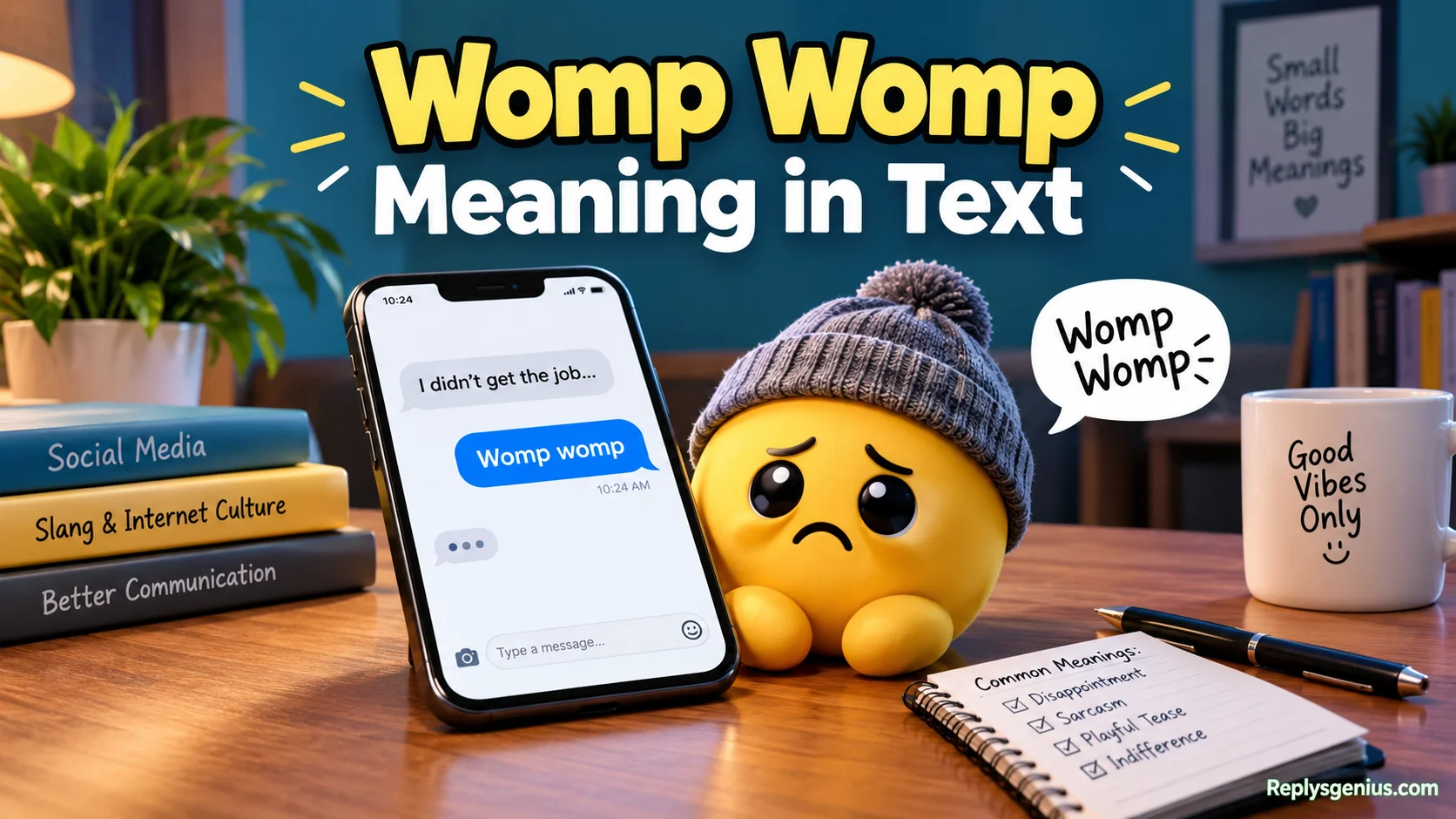
Womp Womp Meaning in Text explains how this popular phrase expresses “too bad” through humor, sarcasm, or a dismissive reaction in everyday conversations.
People use “womp womp” in texting, social media, and casual conversations to react to a small problem or disappointment. It imitates a sad musical sound, making an unfortunate situation seem funny. However, the phrase can also sound insensitive when someone faces a serious problem. Understanding its meaning, origin, and context helps you decide when this expression fits and when a kinder response works better.
The phrase comes from the tradition of using a sad trombone sound to highlight failure or an awkward moment. Its familiar use in comedy, including Saturday Night Live sketches featuring Debbie Downer, helped make the expression recognizable. Today, people use it as online slang to tease friends, react to bad news, or show mock sympathy. The tone depends on the situation, so consider the other person’s feelings before using it.
What Does “Womp Womp” Mean in Text?
“Womp womp” is an informal slang expression used to comment on something disappointing, unsuccessful, or unfortunate, often with a sarcastic or humorous tone. It imitates the sound of a sad trombone playing after something goes wrong.
Think of it as a verbal shrug accompanied by a tiny imaginary soundtrack of failure.
Depending on the conversation, it can communicate several different messages:
- “Too bad.” Something unfortunate happened, but the speaker isn’t making a big deal out of it.
- “Oh well.” The situation didn’t work out, so it’s time to move on.
- “That’s unfortunate.” The speaker acknowledges the problem, sometimes without much sympathy.
- “Better luck next time.” Someone failed at something and might succeed later.
- “I’m not feeling sorry for you.” The speaker is deliberately dismissing the complaint.
- “That’s kind of funny.” The situation is disappointing but harmless enough to laugh about.
For example:
You: I studied for three hours and still got a C on the test.
Friend: Womp womp 😂
Your friend might be joking about your bad luck rather than criticizing your effort. However, if you worked hard and feel genuinely upset, the same response could seem insensitive.
According to the expression is informal American English used to comment on something bad or disappointing, usually humorously.
One important detail: “womp womp” isn’t an acronym. Unlike LOL, BRB, or IDK, it doesn’t stand for a series of words. It’s a sound-based expression that has developed a recognizable meaning in everyday communication.
Where Did “Womp Womp” Come From?
The expression comes from the familiar comedic sound associated with disappointment, failure, or an anticlimactic moment.
Imagine a contestant giving the wrong answer on a game show. Instead of a dramatic announcement, a low, descending musical sound plays. That familiar effect makes the mistake feel even more embarrassing.
People commonly describe this sound as a sad trombone. The written phrase “womp womp” imitates that sound in conversation.
According to the expression was first recorded in the 2005–2010 period. Its entry connects the phrase to the sound of a trombone used to signal a wrong answer or minor humiliation.
The sound itself has a longer history in comedy and entertainment. However, the precise origin of the specific sound effect isn’t established by that date.
The phrase gradually became useful outside television and comedy sketches. People could type it into a conversation instead of explaining that something had gone wrong.
For example:
Person A: I finally bought concert tickets!
Person B: Nice!
Person A: Wait. I bought tickets for the wrong city.
Person B: Womp womp.
The phrase turns an unfortunate mistake into a quick punchline.
For more background, consult the which also explains the expression’s connection to the sad-trombone effect.
How Is “Womp Womp” Used in Text Messages?
Text messages are one of the easiest places to encounter this expression because it delivers a reaction without requiring a full sentence.
Instead of writing, “Well, that’s unfortunate, but there’s nothing we can do about it,” someone can simply type “womp womp.”
The meaning often depends on the relationship between the people texting.
Among close friends, it can be a playful way to tease someone about a minor mistake.
Between acquaintances, it might sound sarcastic or dismissive because the relationship doesn’t provide much context.
During a serious conversation, it can seem insensitive if the sender ignores someone’s genuine distress.
Here are three realistic examples.
Example: Missing the bus
You: I ran outside, and the bus pulled away right in front of me.
Friend: Womp womp 😭
Meaning: Your friend is teasing you about an unlucky moment.
Example: Losing a video game
You: I was one point away from winning the match.
Friend: Womp womp. Skill issue 😂
Meaning: The sender is joking about your loss. Depending on your friendship, this could be harmless banter.
Example: Canceling important plans
You: My family canceled the trip I’ve been planning for months.
Friend: Womp womp.
Meaning: The response might feel dismissive because the trip mattered to you. A more supportive friend would probably ask how you’re feeling.
The key is to consider what happened before interpreting the message. A short reply doesn’t always reveal the sender’s full intention.
What Does “Womp Womp” Mean on TikTok?
On TikTok, “womp womp” often appears in comments, captions, reaction videos, and jokes about unfortunate situations.
The expression works particularly well in short videos because viewers understand the comedic idea quickly. Someone makes a mistake, experiences an awkward moment, or fails at a simple task, and the phrase becomes the punchline.
For example, imagine a creator posting a video about spending an hour getting ready for an event that gets canceled at the last minute.
The caption might say:
“Me getting ready for three hours just to hear that the party is canceled. Womp womp.”
The joke comes from the contrast between the effort and the disappointing result.
People may also use the phrase in comment sections when reacting to a character’s failure, a sports result, or a humorous personal story.
However, its meaning isn’t always friendly. A comment saying “womp womp” under someone’s embarrassing video might be playful, while the same comment under a serious personal disclosure could come across as cruel.
Although the expression appears on TikTok, it didn’t originate there. The sad-trombone idea and the written slang predate the platform.
What Does “Womp Womp” Mean on Snapchat, Instagram, and Other Social Platforms?
The basic meaning remains the same across social platforms. What changes is the context in which someone uses it.
| Platform | Common use | Example |
| Snapchat | Teasing friends in private chats | “You forgot your homework again? Womp womp 😂” |
| Reacting to posts, Stories, and comments | “You missed the sale? Womp womp.” | |
| TikTok | Commenting on funny failures or disappointing outcomes | “Womp womp, the plan failed.” |
| Responding sarcastically to a complaint or setback | “You ignored everyone’s advice. Womp womp.” | |
| Discord | Joking about gaming losses or failed attempts | “Lost the final round? Womp womp.” |
| Casual reactions in private chats and group conversations | “The restaurant is closed today. Womp womp.” |
These are illustrative examples rather than fixed meanings assigned to individual platforms.
On Snapchat, a friend might use the expression affectionately because you already tease each other. On Instagram, someone commenting on a public post might use it to make fun of the person involved.
In a group chat, the phrase can also act as a quick punchline that everyone understands without further explanation.
Remember: The platform tells you where the message appeared, but the conversation tells you what it means.
Is “Womp Womp” Sarcastic, Funny, or Rude?
It can be all three. The expression doesn’t have one fixed emotional tone.
Its effect depends on the seriousness of the situation, the relationship between the people involved, and whether the recipient understands the joke.
| Tone | What it communicates | Example |
| Playful | Friendly teasing about a small mistake | “You burned the toast again? Womp womp 😂” |
| Funny | A disappointing event becomes a punchline | “My pizza landed upside down. Womp womp.” |
| Sarcastic | The speaker responds with exaggerated indifference | “You ignored the instructions and failed? Womp womp.” |
| Dismissive | The speaker shows little concern for someone’s feelings | “You lost something important? Womp womp.” |
| Self-deprecating | The speaker jokes about their own misfortune | “Missed the train by five seconds. Womp womp.” |
Consider two similar conversations.
Conversation A
You: I accidentally wore mismatched socks today.
Friend: Womp womp 😂
The response is probably harmless. The mistake is minor, and the laughter suggests friendly teasing.
Conversation B
You: I’ve been struggling lately, and today was especially difficult.
Friend: Womp womp.
This reply could sound dismissive because you’re sharing something personal rather than making a joke.
A useful rule is to look at the emotional stakes. The lighter the situation, the easier it is for the phrase to land as humor. The more serious the situation, the greater the risk of sounding insensitive.
What Does “Womp Womp” Mean From a Guy or a Girl?
When a guy or a girl texts you “womp womp,” the phrase generally carries the same basic meaning: a humorous, sarcastic, or dismissive reaction to something unfortunate.
The sender’s gender doesn’t determine the meaning. Their relationship with you and the surrounding conversation matter much more.
Here are a few possibilities.
When a friend sends it: They may be teasing you about a minor mistake or disappointing outcome.
When a crush sends it: They might be joking with you, especially if playful teasing is already part of your conversations. However, the phrase alone doesn’t prove romantic interest.
When a partner sends it: They may be making light of a small inconvenience. If you’re discussing something serious, you might reasonably expect a more caring response.
When an acquaintance sends it: The expression may feel colder because you don’t have an established sense of their humor.
For example:
You: I spent all morning baking cookies, and I forgot the sugar.
Crush: Womp womp 😂
This could be a playful invitation to joke about the mistake together.
Now consider a different exchange:
You: I didn’t get the job I really wanted.
Crush: Womp womp.
That response may feel dismissive, especially if the job mattered to you.
Don’t overanalyze two words. Look at the person’s usual texting style, the conversation’s mood, and whether they show care in other ways.
What Does “Womp Womp” Mean With Different Emojis?
Emojis can add humor, exaggeration, or sarcasm to “womp womp.” They can also make an otherwise ambiguous message easier to interpret.
However, emojis aren’t universal signals. The same symbol can mean different things to different people.
| Text combination | Possible tone | Example context |
| Womp womp 😂 | Laughing or playful teasing | Your friend misses the bus. |
| Womp womp 💀 | Exaggerated amusement or ironic disbelief | Someone makes a hilariously bad mistake. |
| Womp womp 😭 | Mock sadness or dramatic disappointment | A favorite team loses. |
| Womp womp 🙄 | Sarcasm, annoyance, or impatience | Someone complains about a predictable outcome. |
| Womp womp 😬 | Awkwardness or uncomfortable humor | Someone makes an embarrassing mistake. |
| Womp womp 🤷 | Indifference or acceptance | Plans fall through, and nobody can change them. |
| Womp womp 🥲 | Playful disappointment with a hint of sadness | A small personal goal doesn’t work out. |
Consider the difference between these messages:
“Womp womp 😂”
The laughing emoji may suggest that the sender sees the situation as funny.
“Womp womp 🙄”
The eye-roll emoji may suggest that the sender is annoyed or unimpressed.
“Womp womp 🥲”
The expression may sound more sympathetic or self-deprecating, depending on the conversation.
Still, don’t judge the entire message by its emoji. The words before and after it often provide better clues.
Read More: 25 Funny Responses to I Disagree: Without Losing Your Sense of Humor In 2026 (With Examples)
Is “Womp Womp” an Insult or a Bad Word?
No. “Womp womp” isn’t inherently a swear word or a direct insult.
It’s an informal expression that people use to react to disappointment or failure. Nevertheless, the way someone uses it can make it insulting or hurtful.
For example:
Harmless use:
Friend: I dropped my sandwich before taking a bite.
You: Womp womp. Five-second rule won’t save that one. 😂
The joke focuses on a minor mishap.
Potentially hurtful use:
Friend: I’ve been dealing with a serious family problem.
You: Womp womp.
The response may suggest that the speaker doesn’t care about the friend’s feelings.
The distinction matters because a phrase can be nonprofane but still unkind. You don’t need to use offensive language to dismiss someone.
If you’re unsure whether the expression is appropriate, consider three questions:
- Is the other person joking about the situation themselves?
- Do you have a relationship where playful teasing is welcome?
- Would the response still seem funny if you were in their position?
If the answer to these questions is no, choose a more considerate response.
What Is the Difference Between “Womp Womp” and “Too Bad”?
Both expressions acknowledge an unfortunate situation, but they often carry different tones.
“Too bad” is a flexible phrase. It can express genuine disappointment, mild sympathy, or sarcasm depending on how someone says it.
“Womp womp” usually adds a comic or sarcastic effect. It evokes the sound of a disappointing outcome rather than simply describing the situation.
Compare these examples.
Example A
You: The concert sold out before I could buy tickets.
Friend: That’s too bad. I know you really wanted to go.
This reply shows sympathy and acknowledges your disappointment.
Example B
You: The concert sold out before I could buy tickets.
Friend: Womp womp 😂
This reply sounds more teasing or ironic, especially if the friend knows you were excited.
Here’s a simple comparison:
| Feature | Womp womp | Too bad |
| Main purpose | React to disappointment with humor or sarcasm | Acknowledge an unfortunate outcome |
| Typical tone | Comic, ironic, or dismissive | Neutral, sympathetic, or sarcastic |
| Formality | Very informal | Informal to neutral |
| Best use | Friendly banter and harmless mishaps | Everyday conversation and mild sympathy |
| Potential downside | Can sound insensitive | Can also sound insincere if delivered sarcastically |
Neither expression guarantees sympathy or rudeness. Tone and context still matter.
What Is the Difference Between “Womp Womp” and “Sad Trombone”?
“Womp womp” and “sad trombone” are closely related, but they aren’t exactly the same thing.
A sad trombone is a musical sound or sound effect that suggests failure, disappointment, or an anticlimactic ending. “Womp womp” is a written or spoken imitation of that sound.
Think of the difference between hearing a door slam and typing “slam” in a message. One is a sound; the other represents it through language.
For example:
Sad trombone: A contestant gives the wrong answer, and a descending trombone sound plays.
Womp womp: Someone types “womp womp” after a friend makes a funny mistake.
The phrase carries the same general comedic idea without requiring an actual musical instrument or recording.
This connection also explains why the expression works well in memes. Readers can imagine the familiar sound even when they only see two words on a screen.
What Does “Womp Womp” Mean in Memes?
In memes, “womp womp” often serves as the punchline after a disappointing, awkward, or unsuccessful event.
The typical structure is simple:
- Someone expects a positive outcome.
- Something goes wrong.
- The phrase highlights the disappointment with exaggerated humor.
For example, imagine a meme showing a person carrying a large stack of books into a library. The next image reveals that the library closed five minutes earlier.
The caption reads:
“Finally motivated to study. Womp womp.”
The joke works because the person’s motivation arrived at exactly the wrong time.
Here are two more original meme ideas:
Meme idea: The failed recipe
Image: Someone proudly removes a cake from the oven. The cake has collapsed in the middle.
Caption: “Followed every step except the important ones. Womp womp.”
Meme idea: The forgotten password
Image: A person confidently opens their laptop and immediately gets locked out.
Caption: “Ready to be productive. Can’t remember the password. Womp womp.”
The humor comes from the gap between expectation and reality.
However, meme culture can also use the phrase to mock people rather than situations. A joke about a burnt cake is different from ridiculing someone over a painful personal experience.
Ten Realistic Examples of “Womp Womp” in Text
The following examples show how people might use “womp womp” in ordinary conversations. Each exchange illustrates a different situation rather than claiming to reproduce an actual private conversation.
Missing the Bus
Alex: I reached the stop just as the bus pulled away.
Jordan: Womp womp 😭
Meaning: Jordan is teasing Alex about an unlucky moment. The crying emoji exaggerates the disappointment for humor.
Losing a Video Game
Mia: I was winning until the final ten seconds.
Chris: Womp womp. Almost had it 😂
Meaning: Chris acknowledges the loss while making the moment less serious.
Forgetting Lunch
Sam: I packed everything except my lunch.
Taylor: Womp womp. Vending machine dinner it is.
Meaning: Taylor responds with lighthearted teasing and offers a humorous picture of what might happen next.
Missing Concert Tickets
Jamie: The tickets sold out while I was checking the seating chart.
Riley: Womp womp. That hurts.
Meaning: Riley mixes playful teasing with a little sympathy. The second sentence softens the response.
Losing a Sports Match
Morgan: My team lost by one point.
Casey: Womp womp. There’s always next season.
Meaning: Casey acknowledges the disappointment and encourages Morgan to look ahead.
Making a Harmless Mistake
Avery: I waved at someone who wasn’t waving at me.
Quinn: Womp womp 💀
Meaning: Quinn finds the awkward moment funny. The response is likely harmless if Avery also sees the humor.
Complaining About the Weather
Taylor: I washed my car, and now it’s raining.
Jordan: Womp womp. The weather app chose violence.
Meaning: Jordan jokes about the unfortunate timing rather than criticizing Taylor.
Canceling Weekend Plans
Chris: The movie night got canceled.
Alex: Womp womp. Guess we’re staying in.
Meaning: Alex acknowledges the disappointment and suggests moving on.
Sharing a Personal Fail
Mia: I practiced my presentation all night and opened the wrong file.
Sam: Womp womp. At least you know the material now.
Meaning: Sam teases Mia but also offers a positive way to view the mistake.
Responding to a Repeated Complaint
Jordan: I skipped breakfast again, and now I’m hungry.
Riley: Womp womp. The consequences have arrived.
Meaning: Riley uses sarcasm because Jordan’s situation follows a predictable pattern.
The takeaway: “Womp womp” works best when the situation is light enough for both people to laugh about it.
How Should You Reply to “Womp Womp”?
If someone sends you “womp womp,” you don’t need to take offense immediately. First, decide whether they’re teasing you, making a joke, or dismissing something important.
Your response can match their tone or make your feelings clear.
Funny Replies to “Womp Womp”
Use these when the conversation is lighthearted and you want to keep the joke going.
- “The sad trombone didn’t have to do me like that.”
- “Thanks for your award-winning sympathy.”
- “I’ll be accepting condolences in the form of snacks.”
- “My villain origin story begins here.”
- “Somewhere, a trombone player just felt a disturbance.”
Example:
Friend: You forgot your umbrella? Womp womp.
You: The weather and I are no longer on speaking terms.
Playful Replies to “Womp Womp”
These responses keep the conversation friendly without sounding overly sarcastic.
- “Laugh now. Your turn is coming.”
- “You’ll understand my struggle someday.”
- “I expect better emotional support next time.”
- “At least I’m consistent.”
- “Let me have my dramatic moment.”
Example:
Friend: You lost the game again. Womp womp.
You: Laugh now. I’m training for my comeback.
Sarcastic Replies to “Womp Womp”
If your friendship includes playful sarcasm, you can respond with a little extra attitude.
- “Wow, such a touching display of sympathy.”
- “Your kindness is truly overwhelming.”
- “I’ll treasure your support forever.”
- “Someone call the empathy department.”
- “And here I thought we were friends.”
Use these carefully. Sarcasm can be funny among close friends but may create tension if the other person doesn’t understand your tone.
Calm Replies to “Womp Womp”
Sometimes, you simply want to acknowledge the message without extending the joke.
- “Yeah, bad timing.”
- “It happens.”
- “I’ll figure it out.”
- “That’s life, I guess.”
- “Moving on.”
These replies are useful when you don’t feel like joking but don’t want to start an argument.
Direct Replies When It Feels Rude
If someone dismisses a serious problem, you can explain what you need without insulting them.
- “I’m actually upset about this.”
- “I know you’re joking, but this matters to me.”
- “I’d appreciate a little understanding.”
- “I’m not looking for jokes right now.”
- “Can we talk about this seriously?”
You don’t owe someone a witty comeback when you’re upset. A clear response is often more useful than trying to win a sarcasm contest.
When Should You Use “Womp Womp” in a Conversation?
The expression is most suitable when everyone involved understands the humor and the situation isn’t particularly serious.
For example, you might use it when a friend misses a bus, burns toast, loses a casual game, or forgets something unimportant.
It also works when you’re joking about your own bad luck.
Example:
“I spent twenty minutes looking for my phone. It was in my hand the whole time. Womp womp.”
Here, you’re making fun of your own mistake. Nobody has to guess whether you intend to ridicule another person.
Before sending the phrase, consider these practical guidelines:
- Know your audience. Close friends may understand your teasing better than new acquaintances.
- Consider the situation. Minor inconveniences are safer targets than serious problems.
- Pay attention to the mood. Someone who is already laughing may welcome the joke.
- Keep the humor mutual. Don’t make one person the constant target of every punchline.
- Be ready to clarify. If someone takes your message the wrong way, explain what you meant.
A little context can make the difference between a funny reply and an unnecessarily hurtful one.
When Should You Avoid Saying “Womp Womp”?
Although the expression is common in casual online conversations, it doesn’t fit every situation.
Someone who shares bad news may need empathy rather than a punchline. Responding with “womp womp” can make them feel that you’re minimizing their experience.
Avoid using it as your first response when someone discusses:
- The death or serious illness of a loved one.
- Losing a job or facing a major financial setback.
- A painful breakup or difficult personal experience.
- Serious anxiety, distress, or emotional struggles.
- A frightening accident or another traumatic event.
For example:
Friend: I didn’t get the job. I really needed it to help pay my bills.
Less considerate response: Womp womp.
More supportive response: “I’m sorry. I know how much that mattered to you. Do you want to talk about it?”
The second response recognizes the person’s feelings instead of treating the situation as entertainment.
You can still use humor later if your friend welcomes it. However, empathy should come first when someone is clearly struggling.
Is “Womp Womp” Still Popular in 2026?
“Womp womp” remains a recognizable expression in contemporary American English and online communication. Dictionary entries and recent examples in published writing show that people continue to use it to comment on disappointment, failure, and misfortune.
For instance,includes examples from 2026, demonstrating that the phrase continues to appear in current commentary.
Its appeal is easy to understand. The expression is short, recognizable, and flexible enough for texting, memes, captions, and spoken jokes.
However, its continued use doesn’t prove that it is growing in popularity or that every age group uses it equally. Those claims would require reliable trend data.
The expression also isn’t exclusive to one generation or platform. Its connection to comedic sound effects predates today’s social-media apps.
In 2026, you can understand “womp womp” as an established informal expression rather than a newly invented abbreviation.
FAQs
1. What does womp womp mean in text?
Womp womp means “too bad” and is often used to react to a small disappointment with humor or sarcasm. It can also show mock sympathy when someone shares an unfortunate situation.
2. Is womp womp rude?
Yes, womp womp can sound rude or dismissive when someone is dealing with a serious problem. Among friends, it may be a playful joke, but context and tone make a big difference.
3. Where did womp womp come from?
The expression comes from a comedic sound effect associated with a sad trombone playing descending notes after a failure or disappointing event. It later became popular in television comedy, online conversations, and internet slang.
4. How do you use womp womp in a sentence?
You can use womp womp to respond humorously to a minor setback. For example, if your friend says, “I forgot my umbrella and got soaked,” you might reply, “Womp womp!” if you both enjoy that kind of teasing.
5. What are other ways to say womp womp?
Some alternatives include “Oh well,” “That’s rough,” “Better luck next time,” and “What a shame.” Choose a phrase that matches the situation and communicates the right level of humor, sympathy, or support.
Conclusion
Understanding Womp Womp Meaning in Text helps you recognize how a simple expression can communicate sarcasm, humor, disappointment, or indifference. People commonly use it in text messages, social media posts, and casual conversations to react to minor problems or tease their friends. Its connection to the sad trombone sound effect gives the phrase its familiar comedic meaning, but the intended message depends on the context.
Before using womp womp, consider how the other person might feel. It can be funny among friends who understand your humor, but it may sound insensitive when someone is facing a serious challenge. If you want to respond more kindly, try “That’s rough” or “Better luck next time.” Choosing the right expression helps you keep conversations natural, respectful, and enjoyable.